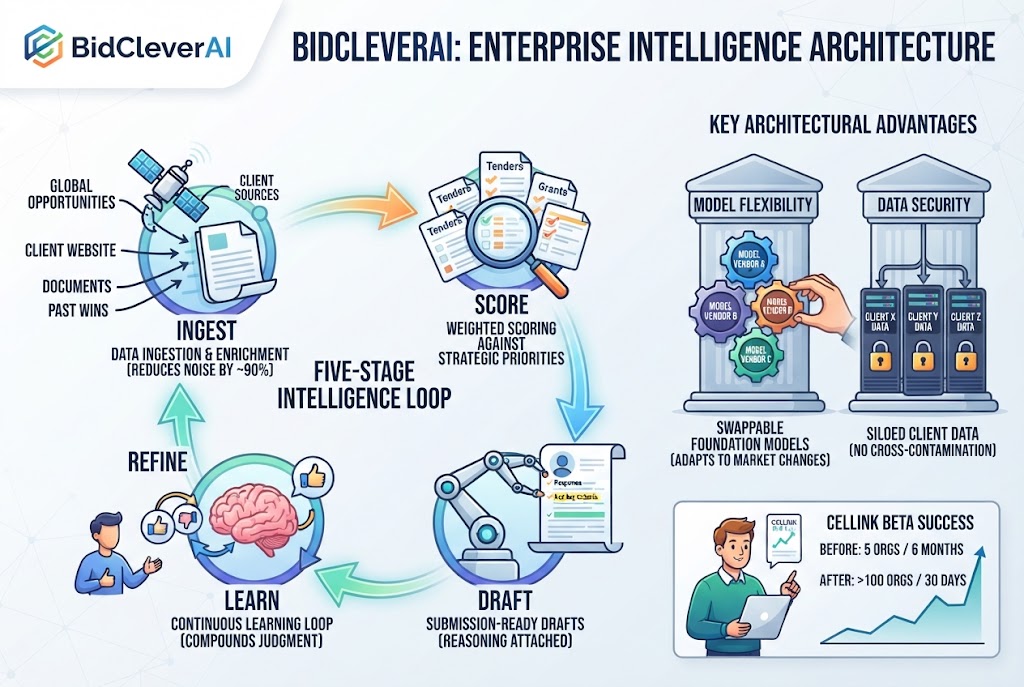
Enterprise buyers want AI that can explain itself, protect their data and avoid locking them into one model vendor. BidCleverAI is building its platform around exactly those demands. The London-based company announced on October 13 that its Clever BI module is commercially available, following a beta with CelLink Corporation, and the architecture behind it matters as much as the launch.
BidCleverAI describes its platform as a five-stage loop. It ingests opportunity data from four global markets every day, enriches it, scores it against criteria specific to each client, drafts responses built on those criteria and then learns from the decisions users make. Each stage feeds the next, and the last one feeds back into the first.
Onboarding starts with the client’s own material. The system ingests a company’s website, documents and past wins to build a detailed profile, then measures every incoming opportunity against it. The company says this step removes roughly 90% of the noise before a person reads anything.
Keyword search is where most opportunity portals stop. BidCleverAI instead applies weighted scoring across the criteria a client cares about, so an opportunity that fits the offering but misses a strategic priority can rank below one that hits both.
The feature enterprise teams are likely to scrutinize first is traceability. Clever Qualifier scores tenders, RFPs and grants daily and attaches the reasoning behind each ranking. A business development lead can see why a result sits where it does, rather than trusting a black-box number.
Clever BI applies the same discipline to market intelligence. In the CelLink beta, every recommended organization came with the commercial connection, the supporting evidence and the most relevant route for engagement. Jeff Parrish, CelLink’s Business Development Manager, put it plainly: “We did not simply receive a list of organizations. We could understand why each one was relevant, how it aligned with our technology and where an opportunity might exist.”
That auditability changes how teams use the output. A recommendation with visible evidence can be challenged, refined and defended in a leadership review. A bare ranking cannot.
The learning stage is what BidCleverAI calls its moat. When users accept, reject or reprioritize results, those decisions refine future qualification. The platform trains, learns and remembers, so the longer a client uses it, the closer the output tracks the way that client actually makes decisions.
The design carries a practical benefit for buyers. The system holds accumulated judgment, not just stored data, so the tool should get sharper with use instead of plateauing after onboarding.
Several infrastructure decisions read like answers to a procurement checklist. The platform runs on AWS as cloud-native infrastructure, and an on-premise deployment option is available for enterprise customers with stricter requirements. Client data is siloed, so one customer’s information does not inform another’s results.
The foundation models underneath are swappable. That detail deserves attention in a market where the leading models change every few months. A platform tied to a single model inherits that vendor’s pricing, limits and roadmap. One built to swap models can adopt better options as they arrive without rebuilding the product around them.
The CelLink beta put those design choices under real load. BidCleverAI analyzed more than 100 organizations across relevant markets. About 36% advanced into the final intelligence portfolio, a deliberately selective cut. Of those, 60% were flagged as immediate commercial priorities and 40% as credible opportunities to develop over time.
According to the company, CelLink had previously analyzed about five organizations every six months. The beta covered more than 100 in 30 days. CelLink makes large-format, high-conductance flexible circuits for automotive, aerospace, industrial, data-center and grid-storage customers, so it needed a way to find partners and routes to market across several sectors at once.
Clever BI extends past customer prospecting. Depending on client goals, it can identify strategic partners, prime contractors, subcontractors, suppliers, consortium participants and competitors. CEO and co-founder Vlad Bonea framed the intent this way: “We wanted to combine AI, market evidence and each client’s own commercial strategy to produce intelligence that is both defensible and useful.”
Clever BI is one of three modules on the same engine. Clever Qualifier handles daily scoring of tenders, RFPs and grants. Clever Bid Writer builds submission-ready drafts from a solicitation’s evaluation criteria and the client’s past submission performance. Clever BI adds pre-RFP signals, primes and partners, drawn from market and government data.
BidCleverAI presents the modules as one platform with a shared ingest, score, draft and learn workflow. A client’s accepted and rejected recommendations sharpen scoring, and the client’s profile is the reference point across the suite. BidCleverAI says this reflects its broader aim: building solutions that adapt to each client instead of asking clients to adapt to a standardized product.
The CelLink beta shows that this approach can turn a research backlog into a prioritized portfolio in weeks. Clever BI is now available as part of the BidCleverAI platform.
Leave a Reply