Federal regulators have thrown out the core of a plan that would have let data centers connect to the nation’s largest power grid faster in exchange for accepting power cuts. The Federal Energy Regulatory Commission (FERC) rejected most of the large-load proposal from PJM Interconnection in an order issued on Friday, October 9, sending PJM back to the drawing board and leaving the question of who pays for data center growth unresolved.
PJM serves the largest U.S. grid and sits at the center of the data center boom in Virginia, Pennsylvania, Ohio and surrounding states. The ruling matters to every developer planning a campus there, and to the utilities and state regulators who will now have to fill the gap FERC left.
What PJM proposed
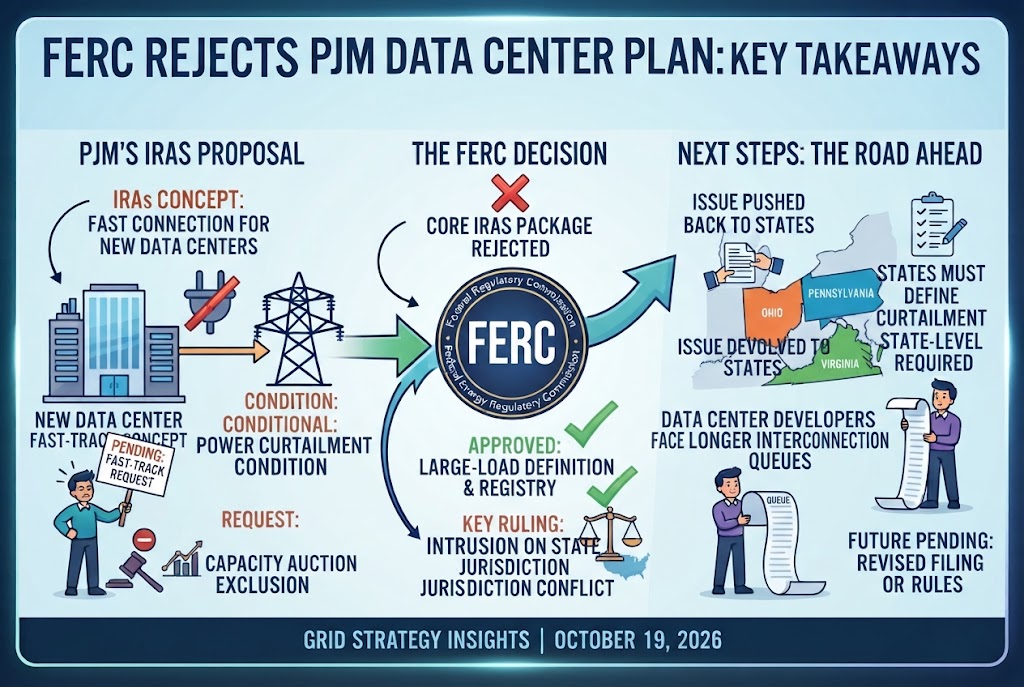
PJM’s package centered on an Interim Resource Adequacy Service, or IRAS. Under it, large loads could connect without PJM first securing matching new capacity if they agreed to be curtailed before grid emergencies. The proposal also included “bring your own new capacity” rules, a definition of large loads, and a registry of facility details such as location, ramp schedule and capacity supply. PJM also wanted to exclude IRAS loads from the demand curve used in its capacity auction.
What FERC approved and what it threw out
FERC kept two pieces: PJM’s large-load definition and the registry. It rejected the IRAS package, which was the heart of the plan.
The commission’s reasoning was legal as well as practical. FERC said several provisions place obligations on new large loads, which are mostly retail customers. It said others dictate which retail customers get curtailed, and that the compensation framework appears to set a retail rate. FERC concluded that the plan intrudes on state jurisdiction over retail rates and appears to discriminate against large loads.
That jurisdiction point is the core of the ruling. Retail electricity service is regulated by states, and the order tells PJM it cannot decide which customers lose power by designing a wholesale market rule.
A commissioner flags a market distortion
Commissioner David Rosner concurred with a warning about the demand curve. Excluding IRAS loads, he wrote, could send a distorted signal: “The result could be a capacity market signaling that PJM has more than enough capacity” while demand is shed involuntarily.
Rosner also pushed the work toward state regulators. “We need state regulators to establish clear rules for which customers should be curtailed first,” he wrote, adding that curtailment should happen only after voluntary demand response is exhausted. FERC itself said states “have a crucial role to play” and encouraged them to keep working on the issue.
PJM’s response
PJM spokesman Jeffrey Shields said the grid operator is reviewing the order. He said PJM aims to meet FERC’s requirements while respecting state responsibilities and protecting existing customers from higher costs or reduced reliability. PJM has not announced changes to its proposal.
The order follows another setback. About five weeks earlier, FERC rejected key elements of PJM’s backstop procurement auction proposal.
Who gains from the delay
Jefferies analysts said the ruling could lead to higher capacity prices for longer. They called the outcome “positive for existing generation/IPPs” and named independent power producers Constellation, NRG, Talen and Vistra as beneficiaries. Existing generators earn more when capacity stays scarce, and a rejected fast-connect plan keeps it scarce for now.
The analysts also expect the proposal to come back in a modified form, likely driven by states. They named Ohio and Pennsylvania as the key states to watch.
What it means for developers
For data center developers, the ruling removes a possible shortcut. Under IRAS, a developer willing to accept curtailment could have reached the grid sooner. Without it, projects face the existing interconnection process, where queues already run long.
The decision also shifts the debate toward the states, which means a patchwork of rules is more likely than a single regional standard. A developer in Virginia may face different curtailment priorities than one in Ohio or Pennsylvania, and each state will weigh data center growth against pressure on household bills.
The competitive angle
The winners from this round are incumbent power producers, who keep their pricing power. The losers are developers and the hyperscalers behind them, including Microsoft, Amazon, Google and Meta, who need power in PJM territory and had a reason to hope for a faster path.
For now, the message from regulators is that data center growth cannot be managed by a grid operator alone, and that the states will have to decide who goes dark first.
Watch the next filing. PJM must decide whether to revise the plan to fit within the limits FERC set, or to wait for states to define curtailment priorities first. Either path takes time, and in the meantime developers must plan around a queue that has not changed.
Leave a Reply