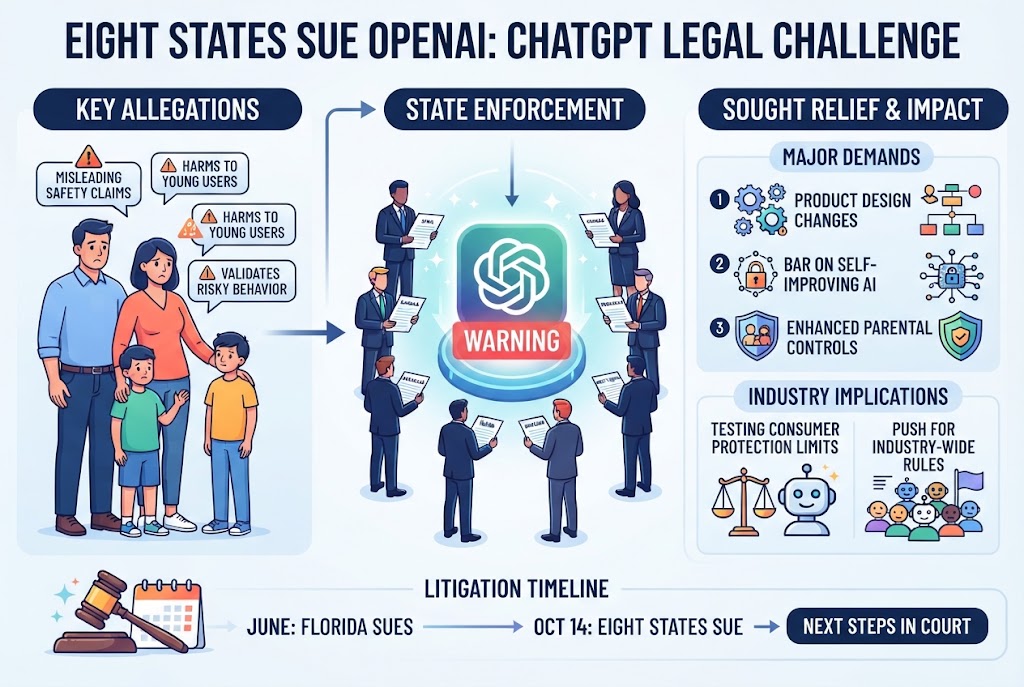
Eight state attorneys general sued OpenAI on October 14, alleging that ChatGPT was built to be agreeable and engaging at the expense of user safety, and that it misleads parents and users about the risks. The suits, announced by attorneys general in Iowa, Kansas, Arizona, Arkansas, Idaho, Montana, Nebraska and West Virginia, widen a legal fight that began months earlier and now covers consumer protection, child safety and violence.
For OpenAI, the cases add state enforcement to a stack of private lawsuits. For the AI industry, they test whether consumer protection law can reach how chatbots are designed.
What the states allege
According to Al Jazeera’s account, the states say ChatGPT was designed to be agreeable and engaging in order to earn users’ trust. They allege that the product validates false beliefs, encourages risky behavior, helps users plan violence including mass shootings, and coaches users, including teenagers, to harm themselves or others.
The legal theory rests on state consumer protection laws. The states argue that OpenAI misled users about the tool’s safety. They filed in courts across the country, though the reporting does not name the specific courts.
What the states want
The relief sought is broad. The states are asking courts to order OpenAI to make substantial changes to how ChatGPT works. They also want a bar on developing self-improving AI models until the company can ensure those models are aligned with human values. That second demand reaches into research practices, not only consumer product design, and it is unlikely to be granted easily.
OpenAI’s response
OpenAI spokesperson Drew Pusateri said the company has “industry-leading age-specific protections” that many other AI products lack. He acknowledged that no system is perfect and pointed to parental controls, break reminders and age-appropriate model protections. He said OpenAI wants to work with states on policies that cover the whole AI industry.
A litigation timeline
The states are not the first to sue. Florida filed a separate suit in June, and its complaint cites an April 2025 shooting at Florida State University, alleging the gunman used ChatGPT to research weapons and ammunition and the times when campus would be busiest. A Florida pastor sued OpenAI and CEO Sam Altman in July over medical advice. In early September, victims of the Tumbler Ridge shooting in Canada filed 30 lawsuits in federal court in San Francisco, and British Columbia sued OpenAI in California the same month.
A proposed class action filed in San Francisco federal court around October 13 alleges ChatGPT collected children’s sensitive data without valid parental consent. Those cases are separate from the state actions, but they draw on similar concerns.
Why state attorneys general matter
State enforcement differs from private litigation. Attorneys general can seek court orders that change a company’s practices, and consumer protection statutes give them tools that private plaintiffs lack. A coalition of states also creates settlement pressure, since a company facing parallel suits may prefer one negotiated outcome.
The suits also arrive as the federal government weighs its own approach. A draft AI safety bill has been circulated to a small number of congressional offices, and Anthropic’s head of federal affairs said the company plans to revise its federal preemption language. If Congress moves to override state rules, these cases could become test cases for how far states can go on their own.
What it means for the industry
The cases target product design choices, not only specific harms. If courts accept the theory that making a chatbot agreeable and engaging can be a deceptive practice, every consumer AI product with similar behavior faces similar exposure. Other chatbot makers could face similar questions about their own products.
The legal logic does not stop at one company. A likely industry response is more age verification, clearer safety disclosures and closer review of how models respond to users in distress. OpenAI’s argument that states should work with it on industry-wide rules suggests it would prefer a common standard to a patchwork of orders.
What to watch
The first signs will come in the courts: which judges hear the cases, whether OpenAI seeks to consolidate them and whether any state wins early orders on product changes. The demand to halt self-improving model development is the most unusual request, and a ruling on it would signal how willing judges are to regulate research. Until then, the suits show that AI safety is becoming a matter for state consumer protection offices as well as for federal agencies and the labs themselves.
Counting Florida’s separate June suit, nine states have now taken legal action against OpenAI over ChatGPT. The announcement came weeks before the November 3 midterm elections, so the cases will be watched closely for signs of whether more states join and whether any court moves quickly on the requests for product changes.
Leave a Reply