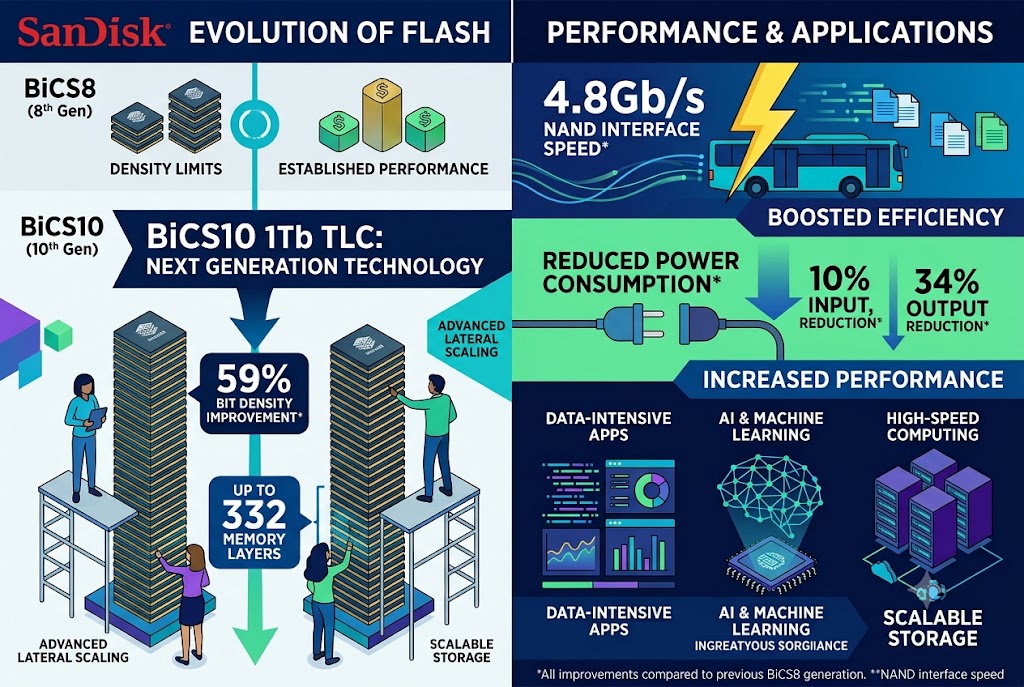
Sandisk has officially started sampling its tenth generation 3D NAND flash memory technology, marking a major leap forward for the data storage industry. Known as BiCS10 1Tb TLC, this new memory architecture is designed specifically to handle the massive data loads generated by modern artificial intelligence and intensive computing environments. By applying advanced lateral scaling techniques, Sandisk has managed to pack an industry leading memory density into a remarkably small footprint, hitting a milestone of greater than twenty-nine gigabits per square millimeter.
The most notable achievement of this new generation is its massive jump in efficiency and spacing. BiCS10 offers a fifty-nine percent improvement in bit density compared to the previous BiCS8 generation. This means manufacturers can fit significantly more storage capacity into the same physical space. Alongside this density boost, the new flash memory delivers up to 4.8 gigabits per second in interface speed, which represents a thirty-three percent performance increase over the eighth generation technology currently in mass production.
To achieve these metrics, Sandisk relied on its proven Bit-Cost Scalable architecture combined with CMOS directly Bonded to Array technology. This bonding process fabricates the logic circuitry and the memory array on completely separate silicon wafers before fusing them together with high precision. By leveraging this method, Sandisk has grown the structure to a staggering 332 memory layers. The chip also incorporates updated systems like Toggle DDR6.0, SCA protocol, and PI-LTT technology to keep operations fast while keeping power limits in check.
Power efficiency is a critical focus for next generation data centers, and the new architecture addresses this by slashing energy demands. Data input power consumption has dropped by ten percent, while data output power consumption has been cut by thirty-four percent compared to BiCS8. Alper Ilkbahar, the Chief Technology Officer at Sandisk, noted that as the world becomes more connected and intelligent, NAND flash memory plays an increasingly mission critical role. He emphasized that BiCS10 builds on a proven foundation to deliver the faster speeds, higher density, and improved power efficiency that customers require for tomorrow’s workloads.
By managing the entire production lifecycle from initial design to final global manufacturing, Sandisk aims to ensure strong supply chain resilience and strict quality control. As sampling begins, this new technology sets a clear roadmap for how the storage industry will scale to support the next wave of data heavy applications.
Leave a Reply