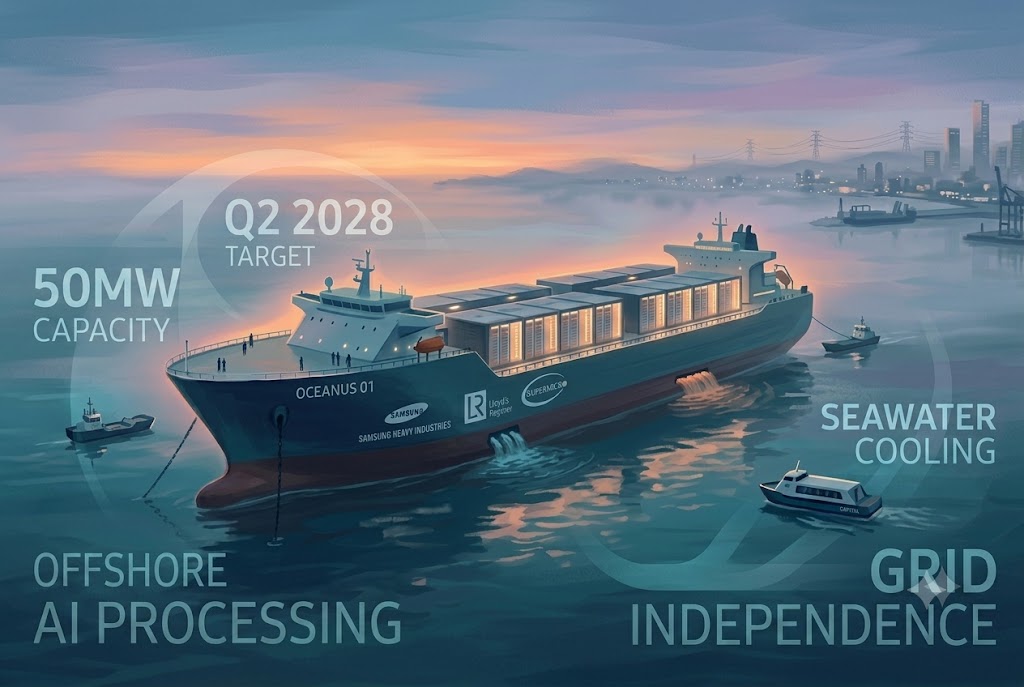
The race to take digital infrastructure off the grid is moving into deep water. Samsung has set a definitive timeline for its ambitious floating datacenter project, aiming to have its first operational, waterborne server facility running by the second quarter of 2028.
The strategy represents a shift in how tech giants and shipbuilders view the future of processing power, particularly as resource-hungry artificial intelligence workloads strain traditional infrastructure. Rather than fighting for increasingly scarce land and power grids onshore, Samsung is looking to the sea.
A New Approach to Digital Infrastructure
Unlike some competitors who plan to retrofit existing cargo ships with server racks, Samsung Heavy Industries is designing and building dedicated, purpose-built vessels from the ground up. The shipbuilding and offshore engineering powerhouse recently solidified key alliances at the Posidonia maritime exhibition, signing cooperative agreements with Greece-based Capital Clean Energy Carriers and Lloyd’s Register. Under this arrangement, Samsung will handle the construction and technical development, Capital will manage the investment and project sourcing, and Lloyd’s Register will navigate the regulatory framework.
The initial goal is to deploy a vessel capable of supporting 50 megawatts of computing capacity. This floating facility is designed to draw power from either onboard generation systems or shore-based hookups, while using the surrounding seawater to naturally cool the immense heat generated by the servers.
Navigating the Elements
Operating high-performance computers at sea presents unique engineering obstacles. Standard data centers are highly controlled, sterile environments. On a floating platform, the delicate components of a server rack must survive constant vibration, physical tilting from ocean swells, highly corrosive salty air, and shifting humidity.
To ensure these systems can withstand the maritime climate, Samsung has partnered with server manufacturer Supermicro. Together, they are launching a joint project to run operational tests on server systems in both river and offshore environments.
The initial 2028 deployment will serve as a critical proof of concept. While the design has already secured initial approvals from maritime safety bodies like the American Bureau of Shipping, proving that an AI-capable data center can run reliably at sea is the final hurdle.
The Driving Forces Behind Floating Tech
The push for maritime servers is born out of necessity. On land, the explosive growth of artificial intelligence has led to a desperate search for three things: massive amounts of electricity, abundant cooling water, and physical space. Floating structures bypass local zoning battles, utilize natural water cooling to reduce energy overhead, and can theoretically be towed to regions where power is cheap or abundant.
With analysts predicting the market for high-performance computing infrastructure to grow exponentially toward the end of the decade, the maritime industry sees a major commercial opening. If Samsung can prove its concept works in 2028, the future of the cloud might just be anchored offshore.
Leave a Reply