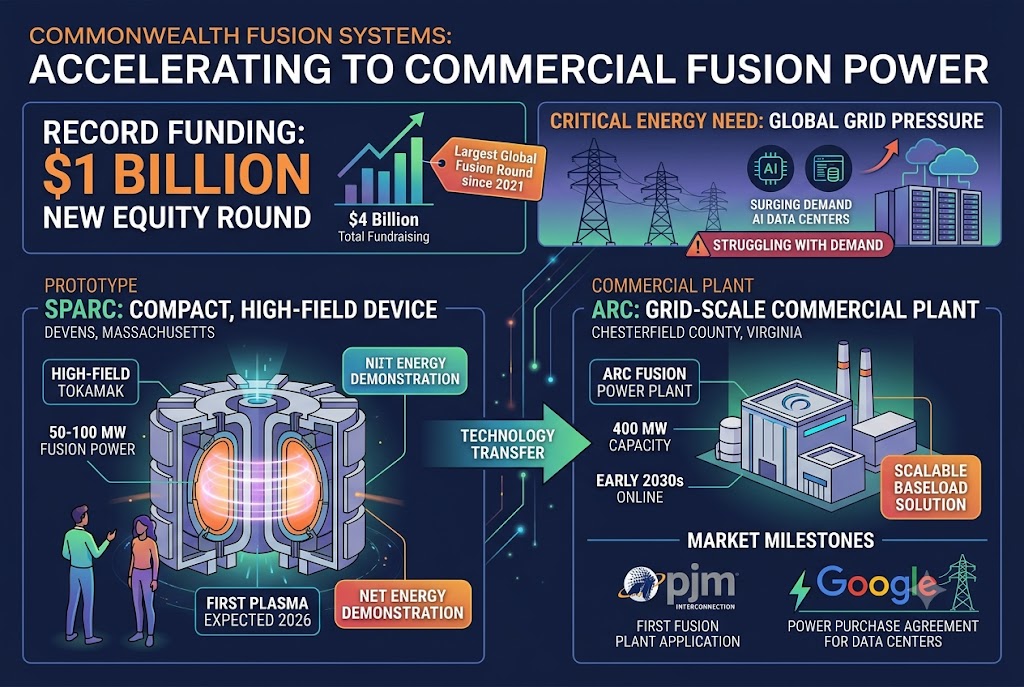
Commonwealth Fusion Systems has raised one billion dollars in a new equity financing round, marking the single largest funding round among fusion energy companies worldwide since CFS announced its $1.8bn Series B round in 2021. This capital surge brings total fundraising by CFS to $4 billion, representing about thirty percent of the overall private investment in nuclear fusion to date.
This massive injection of capital arrives at a critical moment for the global electrical grid. Electrical grids face intense pressure as surging power demand from artificial intelligence and expanding data centers competes directly with the electricity needs of local communities. To avoid driving up energy prices or causing localized power instability, major technology firms and utilities are urgently searching for continuous, zero-emission baseload power.
Founded in 2018 after a spin-off from the Massachusetts Institute of Technology, the company plans to use the new funds to accelerate its path toward commercial power delivery. Development continues on its prototype machine, called Sparc, at headquarters in Devens, Massachusetts. Sparc is designed as a compact, high-field device that matches the footprint of existing mid-sized machines while using significantly stronger magnetic fields to generate between fifty and one hundred megawatts of fusion power. Sparc is expected to produce its first plasma in 2026 and net fusion energy shortly after, demonstrating for the first time a design that will produce more power than consumed.
In tandem with Sparc, the firm is building the world’s first grid-scale commercial fusion power plant, known as Arc, at its Fall Line Fusion Power Station in Chesterfield County, Virginia. Expected to come online in the early 2030s with a capacity of four hundred megawatts, Arc represents a scalable solution to the soaring energy demands of modern digital infrastructure without burdening local communities.
Progress toward grid delivery reached an unprecedented benchmark when the company applied to regional transmission operator PJM Interconnection. The company said the application, submitted to PJM Interconnection, marks the first time a fusion power plant developer has requested to join a major grid operator. Furthermore, technology giant Google has already agreed to buy power from the Fall Line plant, illustrating how technology corporations are actively seeking fusion energy to supply their data centers while easing strain on public electrical networks.
Leave a Reply