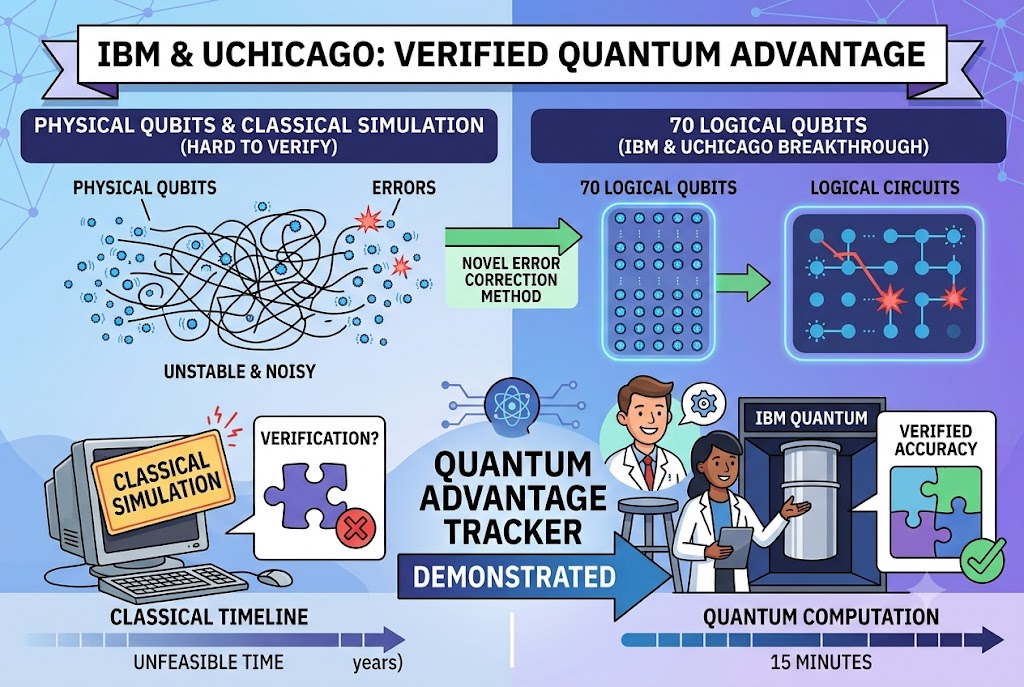
Researchers from IBM and the University of Chicago have achieved a landmark breakthrough in quantum computing by demonstrating quantum advantage while simultaneously verifying the accuracy of the results. The joint effort successfully tackled a computationally complex problem using encoded logical circuits, setting a new benchmark for trust and precision in high-performance quantum processing.
For years, the standard method for proving quantum supremacy relied on random circuit sampling, which challenges quantum processors to produce patterns far too intricate for classical computers to simulate efficiently. However, confirming the accuracy of these computations has historically presented a major obstacle because classical supercomputers cannot easily verify solutions to such complex problems without relying on unproven assumptions.
To solve this challenge, the collaborative team developed a novel alternative to random circuit sampling that retains mathematical hardness while incorporating built-in error detection. By executing 70 logical qubits in one of the largest error correction demonstrations to date, the system carried out 2,415 logical two-qubit operations and 468 logical T gates. The novel quantum encoding lowered effective error rates by a factor of ten compared to physical error rates, ensuring high circuit fidelity throughout the run.
“Verification remains one of the biggest challenges in firmly establishing experimental quantum advantage,” said Bill Fefferman, Associate Professor at the University of Chicago. “This experiment develops techniques to better characterize the fidelity of hard quantum states under noise, increasing confidence that the quantum computer is solving a computationally hard problem.”
The entire quantum computation was completed in roughly 15 minutes, whereas leading classical simulation methods would require an infeasible duration to replicate the same workload. This stark contrast highlights the growing power gap between logical quantum hardware and traditional binary systems.
“Beyond strengthening experimental validation, advances in verification have the potential to unlock practical applications for the next generation of quantum computers.”
By combining error-corrected logical qubits with verifiable results, the research provides a vital framework for scaling quantum systems toward real-world deployment across scientific and commercial domains.
“We are now firmly in the quantum advantage era,” said Jay Gambetta, Director of IBM Research and IBM Fellow. “We have demonstrated a quantum computation beyond the practical reach of classical computers that establishes, with statistical confidence, a lower bound on how faithfully it was executed. This milestone gives scientists, developers, and businesses a new foundation for trusting quantum computers as they scale to problems far beyond what we can achieve classically.”
Leave a Reply