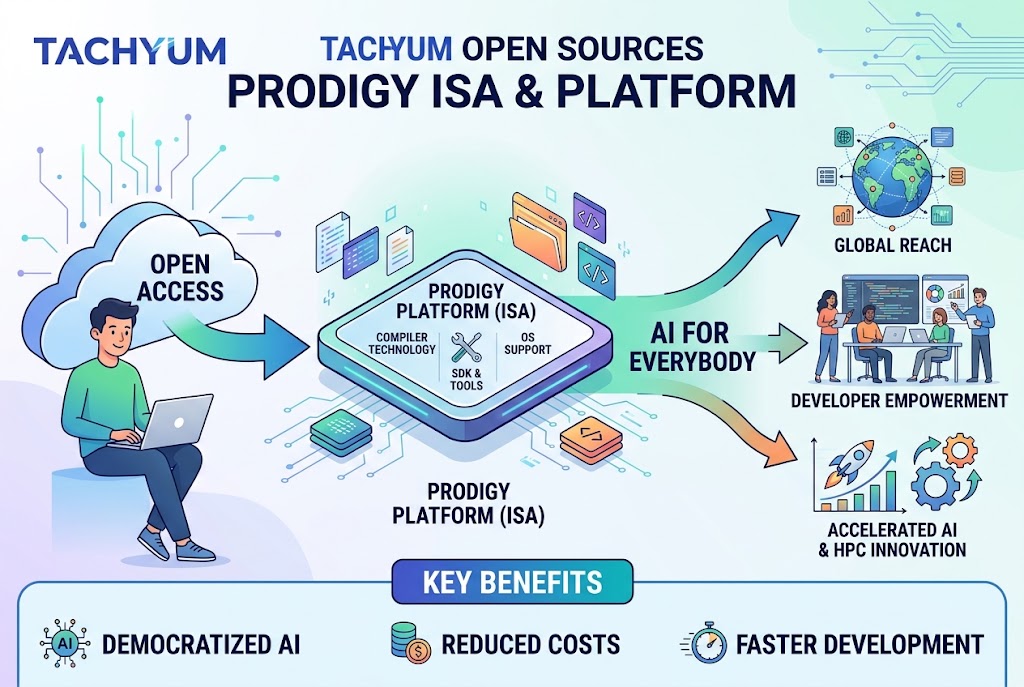
While the semiconductor industry is witnessing a major shift, Tachyum has announced that is has open sourced its complete ISA and software stack worldwide, providing computer scientists direct access to Prodigy Platform. By making its instruction set architecture and entire software stack available to developers, the company has demonstrated tangible progress, however it remains to be seen if this move will reduce skepticism in Tachyum being able to deliver on its disruptive Prodigy claims. Tachyum asserts that engineers and researchers across the globe can now inspect, build, optimize, and validate Tachyum’s open source applications and customer proprietary code, accelerating ecosystem readiness before physical hardware ships.
Critics and competitors have questioned whether Tachyum’s Prodigy architectures could deliver on their ambitious claims. By opening its repository to public scrutiny, Tachyum’s strategy is to offer visibility into its technology. Computer scientists now have direct access to over 70 individual software packages, ranging from low-level system utilities to enterprise-grade workloads. This level of access allows developers to run simulations, evaluate performance, and port critical workloads directly, offering the verifiable proof of technical development to skeptics.
The software release includes deep inspection into instruction-level optimizations and architecture execution. It includes an RTL implementation of IEEE standard-compliant floating-point (FP) operations available at https://github.com/Tachyum-Open-Source/fma-rtl. ISA specification manual is released under the Creative Commons Attribution 4.0 International (CC BY 4.0) license and is available at https://github.com/Tachyum-Open-Source/isa-manual. This release ensures that developers do not need to wait for general hardware availability to start writing compatible applications.
“ARM is shifting from an IP licensing model to becoming a silicon provider, leaving us as the last independent processor architecture, said Dr. Radoslav Danilak, founder and CEO of Tachyum. That independence is essential for technological sovereignty of many countries. As AI becomes increasingly foundational, its underlying technology should benefit everyone, not be controlled by a single company.”
By releasing compiler technology, software development kits, operating system drivers, and artificial intelligence frameworks, Tachyum intends to bridge the traditional gap between silicon design and software readiness. The company claims 5x Superior Efficiency, noting that Prodigy outperforms all industry competitors by running software workloads up to five times more efficiently across the entire stack. Having immediate access to these runtimes allows computer scientists to test these efficiency assertions independently.
This software ecosystem launch directly fulfills Tachyum’s commitment following its November 2025 announcement regarding open sourcing its 281 GB/s TDIMM™ technology, where the company promised to open its Instruction Set Architecture (ISA) and software suite. The ISA specification manual is released under the Creative Commons Attribution 4.0 International (CC BY 4.0) license. It also builds on Tachyum’s earlier licensing momentum, including making its TAI TPU™ technology available for enterprise licensing. Full TDIMM design specifications are released under the Creative Commons Attribution 4.0 International (CC BY 4.0) license available at https://github.com/Tachyum-Open-Source/TDIMM-spec.
Do we think these moves will positively effect the viability of Prodigy’s market penetration? If its CEO Radoslav Danilak’s (https://www.danilak.com/) track record of designing processors is an indicator, then we should at least pay attention to the Prodigy performance claims.
Leave a Reply