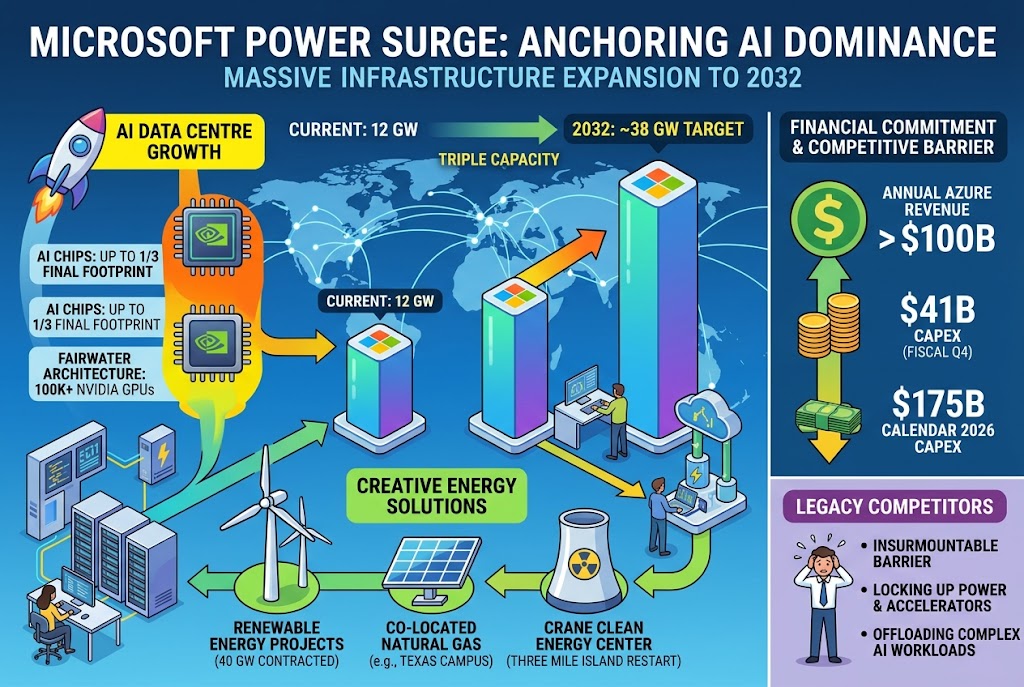
Microsoft is preparing a massive infrastructure expansion to triple its global data centre capacity to roughly 38 gigawatts by 2032, a move that will radically alter enterprise cloud economics and cement its market positioning against hyperscale rivals. The ambitious plan highlights the enormous financial and physical scale required to maintain leadership as artificial intelligence demands surge worldwide.
According to recent reporting, “Microsoft plans to more than triple its data centre capacity to about 38 gigawatts (GW) by 2032, Bloomberg News reported, citing people familiar with the plans.” The company currently operates about 12GW of capacity. Around 2GW of its current baseline is dedicated to AI-specific chips, but that specialized share is projected to reach about one-third of the final planned footprint, expanding AI-focused infrastructure to 12.7GW.
Aggressive Cloud Growth Drives Capacity Limits
The expansion comes as demand for Microsoft cloud services continues to outpace available hardware. During its fiscal fourth quarter ended June 30, the company added 1GW of capacity and brought 31 new data centres online across five continents. Even with these additions, executive leadership confirmed that customer demand continues to exceed available supply.
Azure and other cloud services revenue increased 43% year-on-year in the fiscal fourth quarter, helping propel annual Azure revenue past $100 billion. Total Microsoft Cloud revenue surpassed $214 billion for the fiscal year. Company executives noted that process improvements, which brought new capacity online earlier, contributed directly to quarterly performance because any newly delivered Azure capacity was quickly monetised.
Next-Generation Architecture Demands Radical Power Solutions
To support these high-density compute environments, Microsoft is deploying advanced infrastructure designs like its Fairwater AI data centre architecture, which links hundreds of thousands of Nvidia GPUs. Facilities running these high-performance workloads require up to 140 kilowatts per rack and utilize specialized closed-loop liquid cooling hardware to operate efficiently.
Powering this enormous capacity requires creative energy sourcing. Microsoft has already contracted 40GW of renewable energy projects globally and reached its target of matching its annual global electricity consumption with renewable energy in 2025. Additionally, major developments like its planned 2GW campus in Pecos, Texas will initially utilize co-located natural gas power operating behind the meter. The tech giant has also signed a long-term agreement supporting the restart of the 835MW Crane Clean Energy Center, previously known as Three Mile Island Unit 1.
Capital Expenditure Redefines Enterprise Competition
Funding this unprecedented expansion requires extraordinary financial commitment. Microsoft recorded $41 billion in capital expenditure during its fiscal fourth quarter alone, with roughly two-thirds allocated toward short-lived assets such as CPUs and GPUs. The company expects total capital expenditure of about $175 billion for calendar 2026.
This vast commitment of capital creates an insurmountable barrier to entry for legacy competitors and smaller cloud providers who simply cannot match this level of spending. By locking up gigawatts of power capacity, specialized nuclear and renewable energy contracts, and massive allocations of next-generation accelerators, Microsoft ensures that its infrastructure pipeline remains secure for the next decade. Legacy enterprise providers without deep balance sheets will increasingly be forced to offload their complex AI workloads to hyperscalers, effectively conceding the foundation of modern enterprise software to Microsoft and its immediate cloud rivals.
Leave a Reply