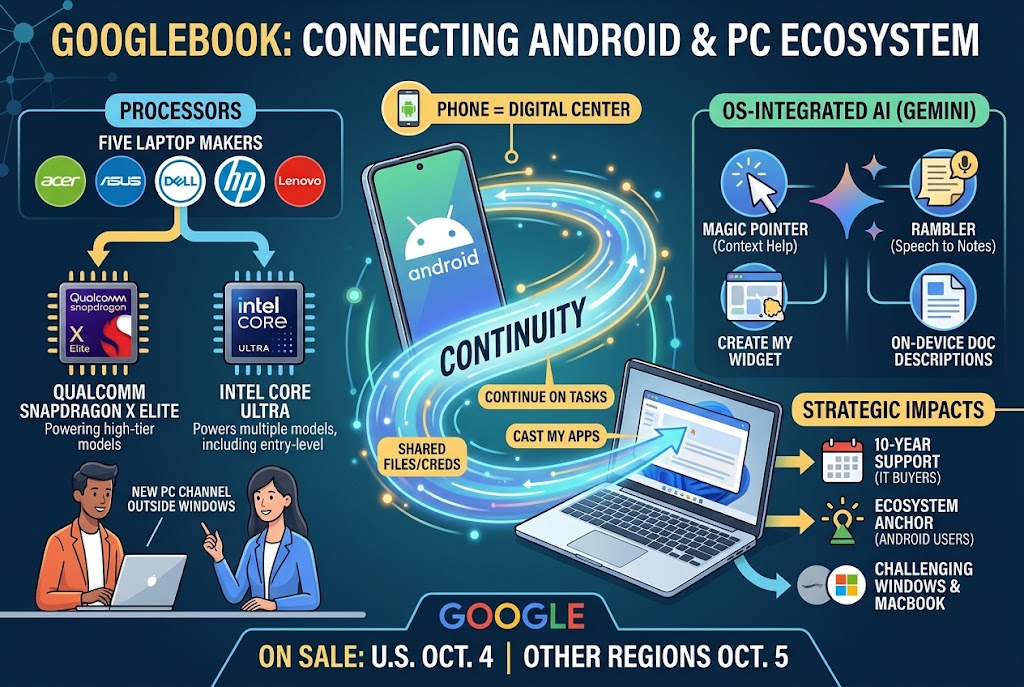
Google opened preorders Monday for Googlebook, a new laptop category that runs Android with ChromeOS desktop elements and builds Gemini AI into the operating system, starting at $899. The launch is Google’s most direct attempt to replicate the iPhone-to-Mac lock-in that anchors Apple’s ecosystem, and it hands Qualcomm a new PC channel outside Windows just as its smartphone chip revenue slides.
The timing is deliberate. Googlebook arrived one day before Qualcomm’s Snapdragon Summit opened, and two of the five launch models run Qualcomm’s Snapdragon X Elite processor.
Five Laptop Makers Split Between Qualcomm and Intel
Acer, ASUS, Dell, HP and Lenovo each built a launch model, according to Android Authority. Dell’s 13.4-inch XPS Googlebook at $1,199 and HP’s 14-inch Googlebook at $1,299 use Snapdragon X Elite. The $899 Acer Googlebook 14, the $1,299 ASUS Googlebook 14 and the $1,299 Lenovo Googlebook 15 use Intel’s Core Ultra processors.
Every model ships with at least 16GB of RAM, a touchscreen and a neural processing unit rated above 40 TOPS. Google promises 10 years of updates with quarterly feature drops. Devices go on sale in the U.S. on Oct. 4, with Canada, the U.K., Ireland, France, Germany and Australia following Oct. 5. MediaTek is positioned as a future chip partner but has no launch model.
The 10-year support window deserves attention from IT buyers. It exceeds the replacement cycle most organizations run on laptops, removing lifecycle risk from the purchase decision and giving Google a procurement argument against Windows machines that face periodic forced upgrades when Microsoft ends support for older releases.
The Android Phone Becomes the Center of the PC
Googlebook’s core pitch is continuity with the phone in a buyer’s pocket. The laptop automatically pulls saved passwords, Wi-Fi credentials and settings from a linked Android phone over an end-to-end encrypted connection. A feature called Continue On lets users start a task on the phone and finish it on the laptop, Cast My Apps streams phone apps into desktop windows without installation, and the Files app reaches directly into phone storage.
“Today, we often switch between starting tasks on our phones and finishing them on our laptops. To make that experience better for Android users, we teamed up with the best laptop makers in the industry,” Google said in its launch announcement, as reported by 9to5Google.
The strategy inverts the traditional PC model. Instead of the laptop anchoring a user’s digital life, the Android phone does, and the laptop becomes a larger screen for it. For Google, that raises the switching cost of leaving Android, the same dynamic that keeps iPhone owners buying Macs.
Gemini Moves Into the Operating System
Google built its AI features into the operating system itself rather than a separate app. Magic Pointer offers context-aware help triggered from the cursor, Rambler converts rambling speech into organized notes, and Create My Widget lets users build desktop widgets by describing them in plain language. The Files app also generates on-device AI descriptions of documents.
Google also bundles 12 months of Google AI Pro, including Gemini Advanced and expanded cloud storage, three months of YouTube Premium, Adobe Photoshop access and a year of Nvidia GeForce Now. The bundle is a subscription funnel: every Googlebook buyer gets a year to build habits around paid Gemini before the renewal decision arrives.
Why Qualcomm Needs Googlebook to Scale
For Qualcomm, Googlebook is diversification with real stakes. The company’s handset revenue fell 20% year over year to $5.09 billion in its most recent quarter, according to Futurum Group, and its Windows PC business has yet to offset that decline. Qualcomm shares closed down 5.82% at $177.72 on Sept. 18 before recovering to $182.87 on Sept. 21 as the Googlebook news landed, according to TradingKey.
Still, Intel captured three of five launch slots, including the $899 entry model that sets the category’s price floor. Qualcomm’s Arm-based chips land only in the $1,199 and up tier.
How Googlebook Shifts the Battle With Apple and Microsoft
Apple set the benchmark Google is chasing. Its MacBook Neo, launched in March at $599, runs the same A18 Pro chip found in iPhone 16 Pro models and ties directly into the iPhone. Google chose not to match that price, aiming Googlebook at premium Windows laptops instead, and it is pursuing Apple’s integration model with five hardware partners rather than one, trading control for reach.
Microsoft has the most to lose. Googlebook targets the same $900 to $1,300 buyers who anchor Windows’ consumer and small-business base, and it offers them tighter phone integration than Windows has ever delivered with Android. If Google converts even a modest share of Android’s global user base into Googlebook owners, it builds the first serious ecosystem alternative to both Apple’s walled garden and Microsoft’s PC dominance, with Qualcomm and Intel fighting over the silicon inside.
Leave a Reply