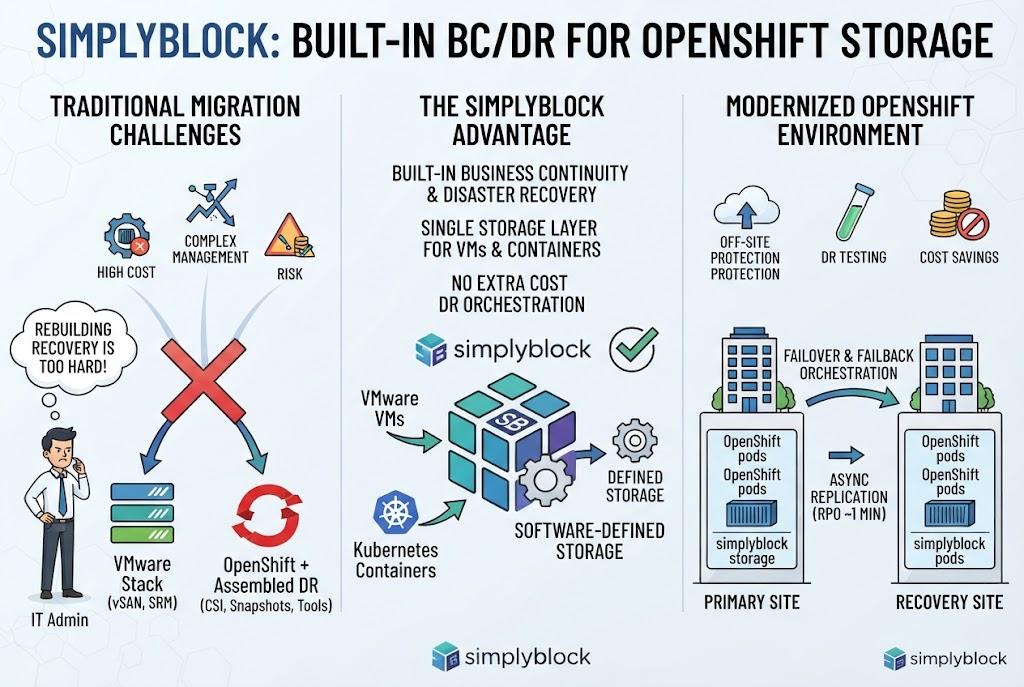
Simplyblock, a software-defined storage startup based in Teltow, Germany, announced Tuesday that its storage platform for Red Hat OpenShift Virtualization and OpenShift Container Platform now ships with built-in business continuity and disaster recovery capabilities. Rather than requiring customers to license a separate DR product on top of their storage, the company is folding synchronous and asynchronous replication, failover and failback orchestration, and off-site protection directly into the platform customers already run.
The move targets a gap that has followed enterprises as they move virtual machines off VMware and onto Kubernetes-based platforms. VMware customers built their recovery playbooks around vSAN, vMotion and Site Recovery Manager, tools that treated storage mobility and disaster recovery as native parts of the stack. “Kubernetes and OpenShift are becoming increasingly popular. However, the lack of built-in business continuity and disaster recovery has made it difficult for many organizations to make the transition from hypervisors or hyperconverged infrastructure,” said Marc Staimer, CEO of Dragon Slayer Consulting, in a statement accompanying the announcement. “CSI shared storage lacks the granularity, business continuity, and low-cost users are looking for. Simplyblock is the first to solve this problem.”
Q: Please tell us about simplyblock and why you started the company and what problems you aim to solve in the market.
Rob Pankow, Co-founder and CEO: Simplyblock is software-defined block storage for Kubernetes and Red Hat OpenShift, serving virtual machines and stateful containers from one storage layer. We started the company around a fundamental shift in the data center: moving from VMware-centered infrastructure toward cloud-native platforms. Traditional storage arrays were built for a different operating model. Connecting an array to Kubernetes does not, by itself, make its hardware economics, management model, and data protection fit the way Kubernetes teams work. We saw an opportunity to build storage around that new environment: software-defined, managed through Kubernetes, and running on standard servers, with enterprise performance, efficient capacity protection, and business continuity built into the platform.
The capabilities announced this week go well beyond a single failover switch. The launch includes protection plans defined at the level of individual VMs, VM groups and consistency groups, with configurable failover, failback, delta-based reprotection, VM boot order and failover sequencing across protection groups, plus DR testing in a separate, network-isolated namespace at the recovery site. On the storage side, simplyblock supports synchronous protection with an RPO of zero in supported metro stretch-cluster deployments, alongside direct asynchronous replication with recovery points as low as roughly one minute, depending on replication progress.

Q: Can you walk us through the new business continuity and disaster recovery features you’re announcing today, and why they matter for companies running OpenShift Virtualization.
Michael Schmidt, Co-founder and CTO: We are extending simplyblock’s storage protection with VM- and container-level disaster recovery orchestration. The launch includes protection plans for individual VMs, VM groups and consistency groups, with failover, failback, delta-based reprotection, VM boot order and failover sequencing across protection groups. It also includes DR testing in a separate namespace at the recovery site, with network isolation from production. For companies running OpenShift Virtualization, that brings the recovery workflow closer to the workloads they operate every day. The storage foundation provides synchronous protection in supported metro stretch-cluster deployments with RPO 0, and direct asynchronous replication with an RPO as low as approximately one minute, subject to replication progress. Async replication sends changes directly to the recovery site without a separate staging store. Backup to S3-compatible object storage and online volume migration are separate storage capabilities. The new orchestration builds on that foundation; guest IP configuration and application-specific recovery procedures still need to be included in the recovery plan.
None of this is to say OpenShift and Kubernetes shops have had no options at all. Backup products, storage snapshots, replication tools and recovery orchestrators already exist across the ecosystem, and plenty of organizations have stitched together working DR programs from them. What they have not had, according to simplyblock, is a single platform where that protection is native rather than assembled.

Q: You’re claiming to be first to solve this problem, so how are organizations handling backup and business continuity for OpenShift/Kubernetes VM workloads today, and what are the gaps or challenges in those approaches?
Rob Pankow, Co-founder and CEO: Organizations already have ways to protect OpenShift and Kubernetes workloads, including backup products, storage snapshots and replication, and recovery orchestration. These can be effective, but assembling the complete solution can mean multiple products, subscriptions, management interfaces and recovery procedures. For teams accustomed to an integrated VMware operating model, assembling those pieces creates extra work. Our approach brings primary storage, efficient data protection and recovery into one software-defined platform for VMs and containers. The launch extends this with workload protection plans and DR orchestration. The value is in reducing the cost and operational complexity of assembling that foundation. Customers can still use established backup tools where they need additional backup management or recovery capabilities. The important test is whether the complete design meets their recovery requirements and can be operated and tested reliably.
Crucially for buyers evaluating the announcement, simplyblock is positioning the new capabilities as part of what customers already pay for rather than a new line item. The company says there is no separate DR product or add-on fee attached to the orchestration features.
Q: Are these business continuity and disaster recovery capabilities included in simplyblock’s current product or are they a separate offering. Will existing customers get access at no additional cost.
Rob Pankow, Co-founder and CEO: These capabilities are part of the simplyblock Enterprise subscription, with no separate DR product or DR feature add-on. This includes VM- and container-level orchestration, which existing Enterprise customers receive without an additional DR feature fee. Customers still need appropriately licensed infrastructure at the recovery site, connectivity and any backup storage they use. The benefit is including the recovery capabilities in the platform subscription.
That packaging decision is the crux of simplyblock’s pitch. The company argues that storage-level DR for OpenShift has historically required licensing premium add-ons separately on every worker node at both the primary and recovery site, a structure that tends to make disaster recovery the single most expensive line in the platform’s total cost.
Q: You claim disaster recovery has typically been the single most expensive component of the OpenShift storage stack, can you explain why that’s been the case, and how simplyblock’s approach avoids those costs?
Rob Pankow, Co-founder and CEO: Up until today, integrating full DR capabilities on both storage and workload-level have required licensing of a combination of SKUs and potentially additional products. With simplyblock, this expensive licensing combination can be reduced to one base SKU such as OKE or OVE or OPP and simplyblock itself, which is substantially cheaper. Moreover, there are significant savings on storage hardware such as NVMe, with cost reduced by up to 50 percent with distributed erasure coding, and compute resources, specifically the share of compute required for storage processing. The overall setup is faster and easier, which saves integration costs. Simplyblock includes DR in Enterprise and uses the same storage platform for primary and recovery environments.
Those hardware savings extend beyond disaster recovery specifically. With server and NVMe pricing climbing industry-wide this year, getting more usable capacity and performance out of the same purchase order has become its own selling point, not just for DR sites but for primary storage generally.
Q: With hardware prices rising globally, how does simplyblock’s software-defined approach help customers reduce their hardware costs or get more out of the infrastructure they already have?
Michael Schmidt, Co-founder and CTO: There are two main opportunities: using suitable hardware more flexibly and using its capacity more efficiently. Simplyblock runs on eligible standard servers with local NVMe or other SSD, including a hyperconverged deployment alongside workloads. That gives customers a way to reuse suitable infrastructure and choose hardware without being tied to a proprietary storage appliance. Erasure coding protects data using data and parity fragments, which requires less raw capacity than storing multiple full copies, saving about half of the raw storage capacity required. Our NVMe-oriented storage engine is designed to deliver performance with low storage-processing overhead. The practical result is a better opportunity to use purchased capacity and compute for applications. While other solutions require up to 25 percent of compute, with simplyblock this number can shrink to a few percent.
That efficiency argument circles back to Staimer’s critique of the broader Kubernetes storage market, which he framed as a choice enterprises have effectively been forced into: pick a Kubernetes-native option that fits the operating model but leaves performance and granularity on the table, or pick a traditional storage array that has the performance but not the integration.
Q: Marc Staimer noted that “CSI shared storage lacks the granularity, business continuity, and low-cost users are looking for.” Can you unpack what’s been missing from existing Kubernetes storage options that has made it so hard for companies to move off VMware or hyperconverged infrastructure?
Michael Schmidt, Co-founder and CTO: As of today, customers have to choose between a Kubernetes-native, hyperconverged or disaggregated storage solution on the one side or storage arrays in the form of appliances on the other. The first model integrates well into the Kubernetes operations model and runs on the same hardware as Kubernetes clusters. However, the offers under this model usually lack important features known to the storage world for a while, such as low latency, high IOPS, storage efficiency and true quality of service. Appliances have these features, but they require specialized hardware, storage networks and engineers; also, integration into workload- or application-level processes such as DR is much harder. Simplyblock provides the best of both: a Kubernetes-native storage platform integrated into application and workload-level with its own DR, with features known from high-performance storage arrays and at topmost performance profiles.
Strip away the feature list, and the pitch to a VMware shop is fundamentally about risk reduction: moving virtual machines to a new platform is disruptive enough without also having to rebuild storage and recovery from scratch as a second project.
Q: In your own words, what problem is simplyblock trying to solve for companies moving from VMware to Kubernetes/OpenShift?
Rob Pankow, Co-founder and CEO: We want companies to move to OpenShift or Kubernetes-based virtualization without making storage and business continuity a second transformation project. Moving the VM is only part of the job. The team still needs dependable performance, efficient capacity, data protection, and a recovery process it can trust. Simplyblock provides that storage foundation for both the VMs they are moving and the containerized applications they will build next. It lets them adopt a cloud-native operating model while keeping the enterprise storage requirements that made those workloads viable in the first place.
Pankow says that pitch has found an increasingly receptive audience over the past two years, as OpenShift evaluations have picked up across the kind of large, VMware-heavy enterprises simplyblock is chasing.
Q: How much of your business today is driven by customers migrating away from VMware, and how has that shifted over the past year or two?
Rob Pankow, Co-founder and CEO: We are seeing a tremendous increase in the number of companies evaluating OpenShift over the last two years. Most of those companies are coming from VMware, alongside a broader shift from VM-centered data centers toward cloud-native infrastructure, where the destination storage architecture needs to be reconsidered as well. Our relevance also extends to organizations adopting OpenShift for new workloads or modernizing an existing Kubernetes environment. In each case, the same question arises: how do you provide enterprise storage and business continuity in a way that fits the new platform?
For an IT team that has spent a decade tuning vSAN and Site Recovery Manager, the more practical question is what the actual migration work looks like day to day, rather than the pitch deck version.
Q: For a company that’s used to VMware’s vSAN, vMotion, and Site Recovery Manager for years, what does the migration path to OpenShift Virtualization with simplyblock actually look like?
Michael Schmidt, Co-founder and CTO: The idea is to allow customers to benefit from the power of the OpenShift ecosystem for new workloads, particularly AI, while at the same time minimizing the risks, timeline and efforts for the migration of legacy workloads through a lift-and-shift approach. OpenShift is not VMware and it is not meant to be. Instead of a proprietary stack of components, it consists of a powerful and evolving ecosystem. With simplyblock, users get more out-of-the-box capabilities alongside their OpenShift deployment. We try to make the mapping of architecture and features as transparent and as easy as possible so that the transition and training can be done as smoothly as possible. A migration is always done in strong alignment with the OpenShift implementation partner and the organization itself. We get involved early in architecture and storage design so the target environment meets existing workload requirements and supports a tested migration and recovery plan.

Asked what customers find most surprising once they are actually running production workloads on the platform, Pankow points to something that has less to do with disaster recovery and more to do with the capital budget line VMware shops often assume they need to clear first.
Q: Of the customers you’ve onboarded from VMware so far, what’s the biggest surprise or benefit they see once they’re actually running on simplyblock?
Rob Pankow, Co-founder and CEO: The biggest surprise for many customers is that modernization doesn’t have to start with a hardware refresh. They can often reuse their existing VMware hardware to run a proof of concept and begin migrating to OpenShift without buying new servers or storage. Simplyblock’s efficient use of storage capacity and hyperconverged deployment help them get more from the infrastructure they already own. That gives them a practical way to modernize in stages: move existing VMs first, then introduce containerized applications on the same storage foundation. They can start the transition without replacing everything upfront or rewriting every application.
Asked what he would tell an IT leader who has not yet started that evaluation, Pankow circles back to a theme that runs through the entire announcement: treat storage and recovery as a day-one architecture decision, not an afterthought bolted on once the VMs have already moved.
Q: Any other thoughts that you would like to add that I missed?
Rob Pankow, Co-founder and CEO: Treat storage and business continuity as part of the platform decision from the beginning. A successful migration means the application performs, its data is protected, and the team knows how to recover it when something fails. Our aim is to make that foundation fit the cloud-native data center: one software-defined storage layer for VMs and containers, efficient use of standard hardware, and storage-level recovery built into the platform. Evaluating those requirements together gives customers a much stronger basis for moving forward.
The announcement lands at a moment when VMware pricing and licensing changes under Broadcom have pushed many enterprises to at least evaluate alternatives, accelerating interest in Kubernetes-native platforms across the industry. That backdrop is likely to keep the spotlight on how OpenShift’s storage ecosystem, from Red Hat’s own Ceph-based OpenShift Data Foundation to third-party platforms like simplyblock, handles the parts of the VMware playbook that enterprises are least willing to give up: knowing their data is protected, and knowing they can get it back.
Leave a Reply