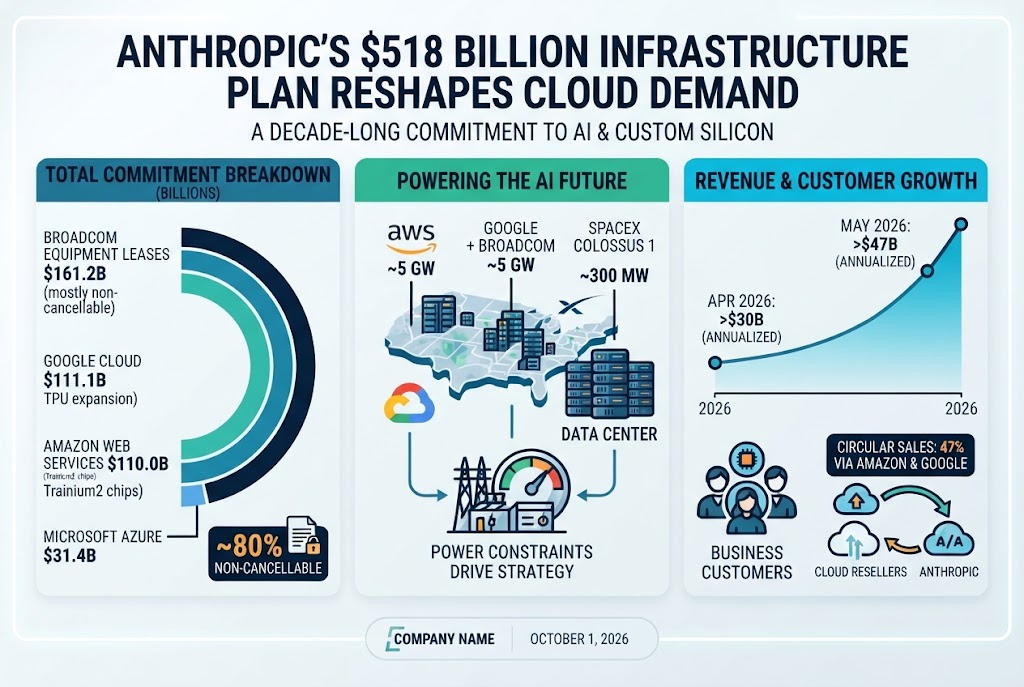
Anthropic has committed roughly $518 billion to AI infrastructure over about a decade, a scale that makes Anthropic one of the largest single buyers of cloud capacity in the market, according to a report from Cloud Computing News. The commitments are split across Google Cloud, Amazon Web Services, Microsoft Azure and Broadcom-linked equipment, and roughly 80 percent of the total is non-cancellable.
The Spending Is Spread Across Three Clouds
The report breaks the total down by provider. Google Cloud accounts for $111.1 billion and Amazon Web Services for $110 billion. Microsoft Azure represents $31.4 billion, including a $30 billion compute commitment. Broadcom equipment leases add $161.2 billion, which the report describes as largely non-cancellable.
That mix is the strategy. Anthropic is not tying itself to one hyperscaler. It is buying capacity from all three and from custom silicon on two different architectures, which gives it leverage in every negotiation and protects against a shortage at any single provider.
Custom Silicon Is Carrying the Load
The hardware detail is where the competitive story sits. On AWS, Anthropic is using more than one million Trainium2 chips, with up to 5 gigawatts of additional capacity in play and Trainium2 and Trainium3 availability expected by the end of 2026. On Google, the plan calls for expansion toward up to one million TPUs, with capacity delivered during 2026 and next-generation TPUs available in 2027. The Google and Broadcom arrangement covers 5 gigawatts.
The report also notes that AWS’s custom chip business had passed a $20 billion revenue run rate in early 2026. Anthropic’s commitments are a large part of the demand behind that number, and a visible validation of both Amazon’s and Google’s in-house chips as alternatives to Nvidia GPUs.
Revenue Has to Catch Up to the Bill
The commitments only work if revenue keeps climbing. The report puts Anthropic’s 2025 compute and infrastructure spending above $7 billion and its 2025 operating loss above $8 billion. Annualized revenue was above $30 billion in April 2026 and reached $47 billion in May. More than 1,000 business customers now spend over $1 million a year.
Cloud resellers are a major channel. About 47 percent of Anthropic’s 2025 sales passed through Amazon and Google, so the companies selling Anthropic its compute are also selling Anthropic’s models to their own customers. That circularity is good for both sides while demand grows, and a concentration risk if it slows.
Power Is the Real Constraint
Capacity in this plan is measured in gigawatts, not server counts. Up to 5 gigawatts of additional AWS capacity and a 5 gigawatt Google and Broadcom agreement put Anthropic’s footprint in the range of utility-scale power demand. The report also lists more than 300 megawatts and over 220,000 Nvidia GPUs at SpaceX’s Colossus 1 among its compute sources, showing that Anthropic is willing to buy capacity wherever it can get it.
That has consequences for every provider. Whoever can secure land, grid connections and chips fastest wins the next tranche of commitments, and the providers with their own silicon are better placed to control cost per unit of compute.
The Risk of Non-Cancellable Contracts
With about 80 percent of the commitments non-cancellable, Anthropic has little room to retreat if growth stalls or if more efficient models reduce its compute needs. Competitors with more flexible arrangements could adjust faster. Anthropic has chosen certainty of supply over flexibility, a trade that pays off if capacity stays scarce.
What It Means for the Cloud Market
For the hyperscalers, the plan is a locked-in backlog. Microsoft reported Microsoft Cloud revenue of $59.3 billion in its fiscal fourth quarter of 2026, up 27 percent year over year, and a $31.4 billion Anthropic commitment adds to that pipeline. Google and Amazon, with commitments above $110 billion each, gain the largest share.
For OpenAI and other rivals, the message is about scale: securing multi-gigawatt supply years in advance is now the price of staying competitive at the frontier. For legacy enterprise cloud vendors without large custom silicon programs, the plan is a reminder of how much AI demand is flowing to the three largest providers and their chip partners.
Leave a Reply