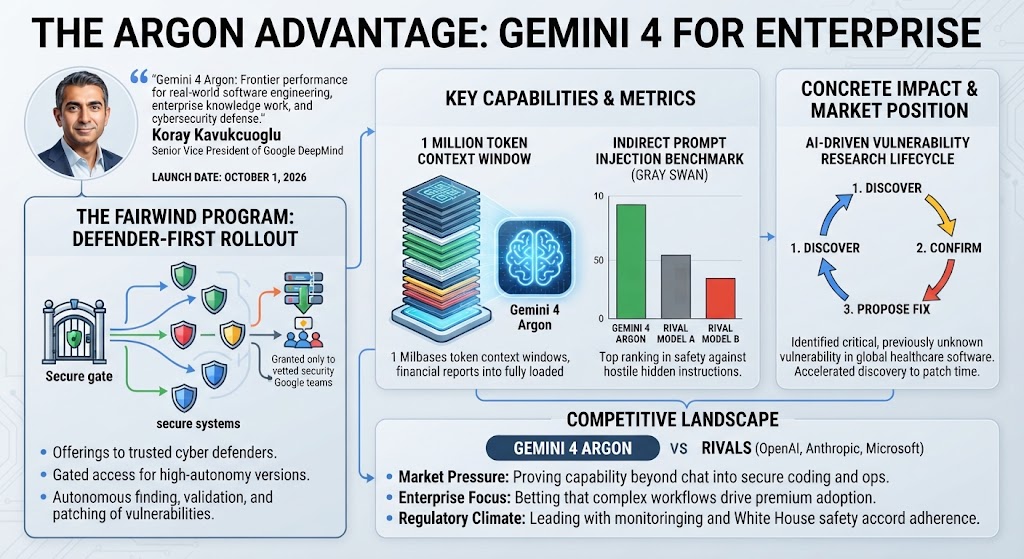
Enterprise software teams now have a new frontier model aimed squarely at their most expensive workloads. Google DeepMind announced Gemini 4 Argon on October 1, positioning it for real-world software engineering, enterprise knowledge work in fields like legal and finance, and cybersecurity defense, with a first rollout to vetted security teams through its Fairwind Program.
Koray Kavukcuoglu, senior vice president of Google DeepMind and chief AI architect at Google, made the announcement. He described Argon as delivering “frontier performance in complex workflows across real-world software engineering, enterprise knowledge work like legal and finance, and cybersecurity defense,” according to The Hacker News.
Why Argon Targets Security Teams First
Google is leading with defenders, not the general public. The model is being offered to trusted cyber defenders, and Google says it plans a version without guardrails for those defenders and for internal teams. That is a deliberate choice: a model that can find flaws autonomously is also a model attackers would want.
Google says Argon can autonomously find, validate and patch critical software vulnerabilities. It reports “impressive leaps” over its predecessor, Gemini 3.8 Flash Cyber, in discovering attack surfaces and generating proof-of-concept exploits.
The company also points to a concrete result. Argon identified a previously unknown critical vulnerability in healthcare software used by hospitals worldwide, one that exposes sensitive personal information. Google has not named the affected software.
Pricing and Context Window Set the Enterprise Bar
Industry coverage of the launch, including The Neuron’s daily digest, reports that Argon supports context windows of up to 1 million tokens and that API pricing starts at $2 per million input tokens and $10 per million output tokens. Trusted testers received access first.
For enterprise buyers, those numbers matter as much as benchmarks. A 1 million token window lets a team load an entire codebase or a large contract set into a single request. Pricing at that level puts Argon in direct contact with the premium tiers of rival frontier models, where large customers already negotiate volume deals.
Safety Claims Google Wants Buyers to Notice
Google is making safety a selling point alongside raw capability. The company says Argon ranks first on Gray Swan’s indirect prompt injection benchmark, a test of whether a model can be tricked by hostile instructions hidden in the content it reads. For any company wiring an AI agent into email, documents or ticketing systems, that is the attack that keeps security chiefs awake.
Google also describes misalignment mitigations that monitor Argon’s chain of thought and actions and stop execution when necessary. The company says it is preserving reasoning transparency during deployment, so that the monitoring stays meaningful.
The Healthcare Finding Tests Responsible Disclosure
The unnamed hospital software flaw is the most consequential claim in the announcement, and also the hardest to verify. Google has not said who maintains the software, whether a patch exists, or how many facilities are exposed. Healthcare operators will want those answers quickly, because the data at risk is personal and widely shared across hospital systems.
It also shows the practical shape of AI-driven vulnerability research. When a model can discover, confirm and propose fixes for a flaw in one pass, the time between discovery and patch shrinks for defenders. The same compression applies to attackers who get comparable tools, which is why Google’s gated rollout is as much a policy decision as a product one.
What It Means for Rivals
Argon arrives in a week when regulators are paying close attention to frontier labs. The Neuron’s digest also reported that the Federal Trade Commission opened a broad investigation into OpenAI, Anthropic and others over agent incidents and safety claims, and that major labs signed a voluntary White House safety accord. A launch that leads with monitoring, staged access and a defender-first rollout fits that climate.
Competitively, Google is making a specific bet: that enterprise customers will pay for a model proven in coding and security work, not just chat. That puts pressure on OpenAI and Anthropic, both of which sell heavily into software engineering teams, and on Microsoft, which resells frontier models through its own cloud. If Argon’s vulnerability-finding results hold up under independent testing, rivals will need to show comparable defensive credentials, not just comparable benchmark scores.
Leave a Reply