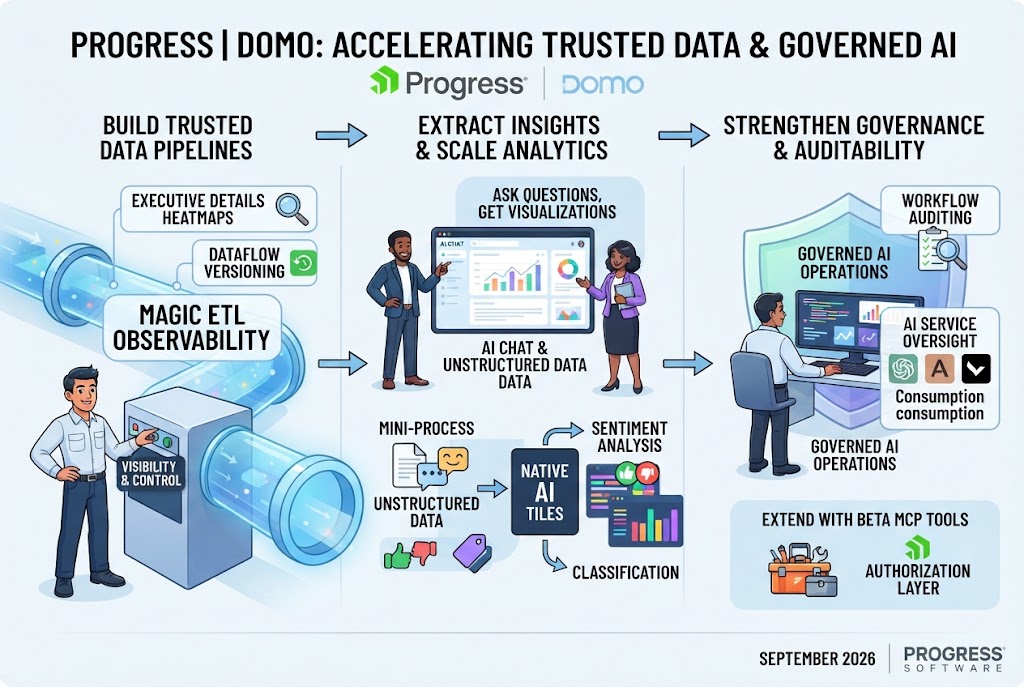
Enterprise infrastructure efficiency and operational scale are hitting a major inflection point as organizations demand absolute trust in their automated systems. Progress Software is aggressively reshaping that landscape with its September 2026 product release for the newly-acquired Domo data and AI platform, delivering advanced Magic ETL capabilities and tighter governance controls designed to eliminate operational friction at scale.
Why Infrastructure Visibility Alters the Competitive Balance
Data teams have long struggled with opaque transformation pipelines that make troubleshooting a reactive guessing game. Progress Software addresses this head on by introducing advanced observability features to Magic ETL, including Executive Details Heatmaps and DataFlow Versioning. These additions give engineers granular visibility into how data changes as it moves through a pipeline, highlighting processing bottlenecks and enabling teams to compare current workflows against previous versions. As John Ainsworth, EVP and General Manager, Application and Data Platform, Progress Software, noted, organizations do not need more data and tools. They need confidence in the information insights and business processes that drive decisions, and this release helps customers move faster from trusted data to governed AI-powered outcomes while maintaining the visibility and control required at enterprise scale. By shortening the time required to optimize pipelines, the platform slashes infrastructure maintenance overhead and establishes a new benchmark for data reliability that legacy competitors simply cannot match.
Unlocking Unstructured Data Without Custom Scripts
Extracting actionable value from customer feedback, support interactions, and text-based content has traditionally required cumbersome custom scripts or expensive external API integrations. Progress Software has integrated native AI-powered capabilities directly into Magic ETL to solve this bottleneck. The new Sentiment Analysis Tile evaluates text from sources such as surveys and support tickets, while the Classification Tile organizes unstructured text into predefined categories or custom tags natively. Furthermore, a multi-statement SQL tile improves flexibility for technical users, enabling efficient data preparation and transformation across complex datasets. This streamlined approach allows enterprises to process unstructured inputs instantly, reducing reliance on third-party middleware and cutting down on unnecessary compute expenses.
Scaling Active Analytics Through Intelligent Chat
Moving quickly from raw questions to concrete business actions remains the ultimate bottleneck for business intelligence adoption. Domo AI Chat now shatters this barrier by analyzing multiple DataSets and documents in a single conversation, helping users evaluate information across disparate sources, generate interactive visualizations, and initiate business processes seamlessly. Organizations can accelerate decision making while maintaining strict permissions and governance controls. Administrators can configure specialized assistants for particular applications, while DomoStats records Domo AI Pro operations for comprehensive review. This shifts the chat interface from a passive search utility into an active analytics builder that empowers non-technical stakeholders to drive operational execution safely.
Establishing Rigorous Oversight Over AI Operations
As enterprise AI adoption scales, the risk of unmonitored workflows and bloated package dependencies creates severe security and cost vulnerabilities. Progress Software is tackling this challenge head on by introducing new workflow auditing capabilities and enhanced package management that identifies application dependencies, allowing developers to remove obsolete packages without breaking underlying processes. Additionally, the platform introduces new AI Admin Connectors that provide immediate visibility into AI service consumption across prominent third-party providers including OpenAI, Anthropic and Cursor. Organizations can combine these insights with internal employee directories to examine usage by team or cost center, ensuring total accountability and cost control across every department.
Expanding Capabilities Through Strategic Beta Releases
Innovation on the platform continues to accelerate with a robust slate of beta features designed to extend automation across enterprise data operations. Domo customers can now test an expanded AI Library featuring beta Model Context Protocol toolkits that facilitate operational work through authorized assistants. Users can ask an assistant to design a workflow, guide an application through a Domo Sandbox promotion, and conduct routine tasks like alerts and workspace upkeep with the assurance that all actions are subject to existing user permissions. Furthermore, Snowflake Semantic Views allows customers to leverage established Snowflake relationships and metrics directly in Domo without copying underlying data or rebuilding duplicate logic, ensuring Snowflake remains the single source of truth while analysts operate at maximum speed. Additional beta inclusions such as the Calculated Columns Rule Builder, Activity Log Webhooks, and cloud integration calendar updates for major data warehouses cement Progress Software as a formidable powerhouse in modern enterprise infrastructure.
How This Redefines the Enterprise Software Landscape
When evaluating this release against legacy analytics providers, the strategic shift is unmistakable. Traditional platforms force enterprises to choose between velocity and governance, often requiring massive custom engineering overhead to bridge the gap between raw data pipelines and secure AI execution. Progress Software has systematically eliminated that compromise by embedding observability, automated classification, and granular cost tracking directly into the core fabric of the Domo platform. By bridging the gap between trusted data preparation and auditable AI automation, the company is not just updating an analytics tool. They are setting a completely new standard for how enterprise infrastructure must operate in an AI-first world.
Leave a Reply