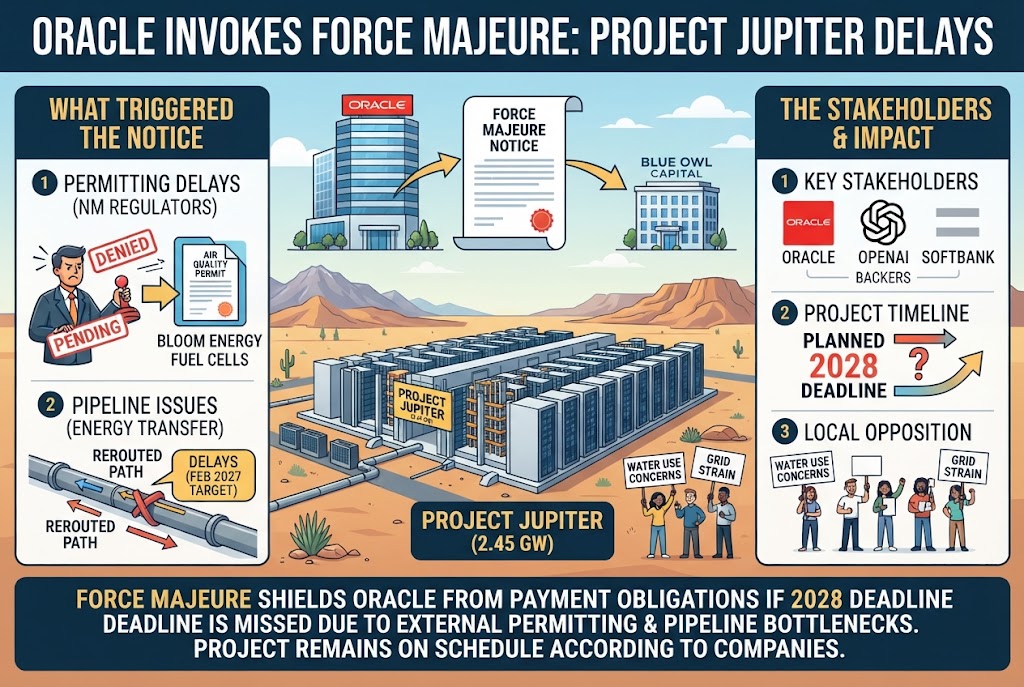
Oracle has sent a force majeure notice to developer Blue Owl Capital over Project Jupiter, the massive Stargate data center campus under construction in New Mexico, according to a report published by Bloomberg News. The notice shields Oracle from payment obligations tied to the facility should it miss its 2028 operational deadline, and shares of the company slipped roughly 3 percent following the report, according to CNBC.
Project Jupiter is one of the flagship sites in the Stargate initiative, the data center buildout backed by Oracle, OpenAI and SoftBank that was announced early in President Trump’s second term. The campus is designed to draw 2.45 gigawatts of power, a scale that places it among the largest AI infrastructure projects under development in the country.
What triggered the notice
The force majeure filing points to a stack of infrastructure delays rather than a single failure. An Energy Transfer natural gas pipeline meant to supply power to the site has slipped six months, with a new target of February 2027, after regulators repeatedly rejected the original permit application. The pipeline’s rerouted path came only after the earlier proposal was denied.
Separately, an air quality permit covering the Bloom Energy fuel cells that are meant to power the campus remains pending before New Mexico regulators, who face a November 23 deadline to act on it. Any further slippage on that permit would compound the timeline pressure already created by the pipeline delay.
Both companies have pushed back on the idea that the project is in jeopardy. “Project Jupiter remains on our planned schedule,” Oracle said. Blue Owl, for its part, said the force majeure notice “does not change the financial commitments to this multi-year project,” signaling that the developer does not view the filing as a sign Oracle is walking away from its obligations.
A politically charged build
The New Mexico campus has become a lightning rod in its region. Environmental groups and local residents have organized against the project ahead of the midterm elections, citing concerns over water use, air quality and the strain large data centers place on regional power grids. Oracle has responded with a public outreach campaign aimed at addressing those community objections, though the force majeure notice is likely to give critics fresh ammunition.
The episode is also a reminder of how exposed the current wave of AI data center construction is to permitting bottlenecks well outside the control of the companies funding it. Gas pipeline approvals, air quality permits and interconnection queues have increasingly become the binding constraint on how fast hyperscalers and their partners can bring new AI capacity online, even when capital is not the limiting factor.
What it means for Stargate
Oracle, OpenAI and SoftBank have positioned Stargate as a cornerstone of the United States’ AI infrastructure buildout, with Project Jupiter among its largest individual sites. A force majeure notice does not cancel the project, and both Oracle and Blue Owl insist the timeline is intact. But invoking the clause at all signals that Oracle wanted formal legal protection against the possibility that permitting delays, not construction or financing problems, push the 2028 deadline out of reach.
For an industry racing to bring gigawatts of new AI compute online, Project Jupiter’s stumble is a case study in how quickly a marquee project can run into friction once it leaves the drawing board and meets state regulators, utility interconnection queues and local opposition. Whether Oracle’s optimism about the 2028 timeline holds up will depend largely on decisions well outside Silicon Valley, in a New Mexico state permitting office.
Oracle has staked much of its enterprise cloud growth story on Stargate and the broader wave of AI infrastructure spending, and investors have rewarded that bet with a valuation increasingly tied to how quickly the company can deliver compute capacity to OpenAI and other AI customers. A stalled marquee site, even temporarily, cuts against that narrative, which helps explain why the stock reaction outpaced what the underlying legal filing, a routine contractual protection against delay, would normally justify on its own.
Leave a Reply