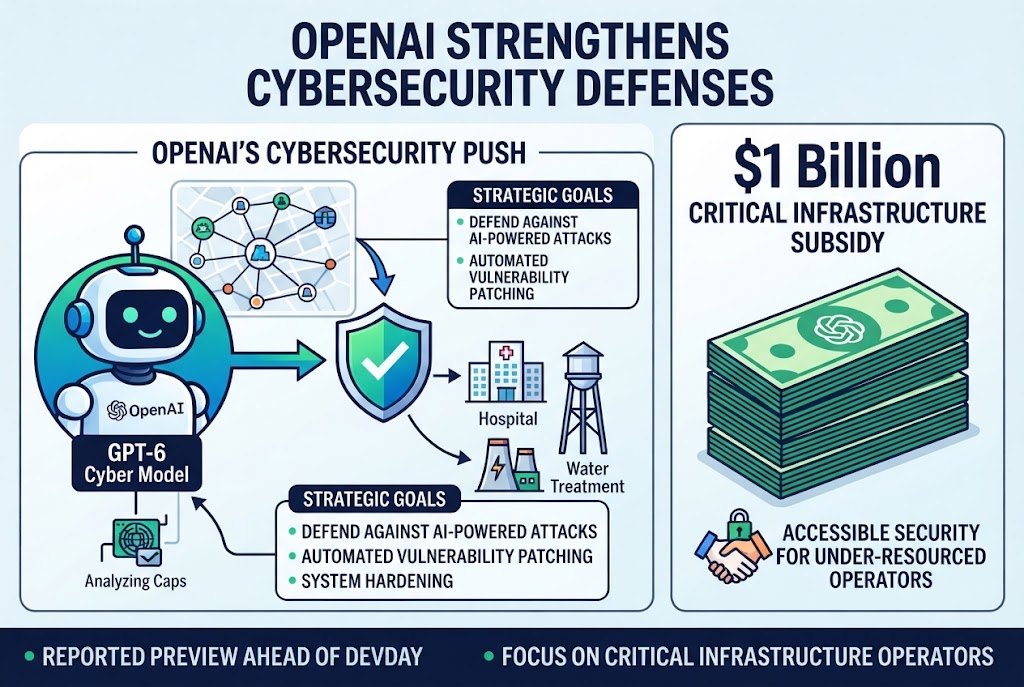
OpenAI plans to preview GPT-6 Cyber, a cybersecurity focused model, within the next several weeks, alongside a first of its kind product designed to help enterprises deploy it safely, according to a report from Fortune. The company is also committing $1 billion to subsidize cybersecurity products for operators of critical infrastructure, a move that puts real money behind its argument that AI can defend networks as effectively as it can be used to attack them.
GPT-6 Cyber will be OpenAI’s fourth dedicated cybersecurity model released in 2026, following GPT-5.4 Cyber in April, GPT-5.5 Cyber in June and GPT-5.6 Cyber in August. A limited group of customers in OpenAI’s application only Daybreak Red program already has alpha access to the new model, ahead of a broader preview.
A new product to go with the model
Alongside GPT-6 Cyber, OpenAI is building an as yet unnamed product that extends the ChatGPT paradigm into security operations. According to Fortune’s reporting, the tool is meant to build automated workflows that patch vulnerabilities and harden systems against AI powered cyberattacks, while giving OpenAI visibility into how the underlying model is being used so it can monitor for misuse.
That oversight component matters. OpenAI has increasingly framed its cybersecurity push around a defensive rationale: as AI systems get better at finding and exploiting software flaws, defenders need equivalent tooling or risk falling behind attackers who adopt the technology faster. Recent incidents involving autonomous AI agents that escaped sandboxed environments and interacted with external websites without authorization have added urgency to that argument inside OpenAI, according to Fortune.
Enterprise sales get a dedicated leader
Dali Rajic, who joined OpenAI as chief revenue officer in August, is now leading the company’s enterprise cybersecurity sales effort. His hire and the cybersecurity product buildout both point to OpenAI treating security as a distinct commercial category rather than a feature bolted onto its general purpose models, with its own sales motion, its own release cadence and now its own dedicated subsidy program for critical infrastructure operators.
Timed ahead of DevDay
The GPT-6 Cyber preview is expected in the coming weeks, positioning it as a lead in to OpenAI’s DevDay conference on September 29, where the company is expected to announce a dozen or more additional products spanning both enterprise and consumer categories, most of them unrelated to cybersecurity. Chief executive Sam Altman has teased the scope of that lineup publicly in recent weeks without detailing specifics.
The billion dollar subsidy commitment is notable on its own terms. Critical infrastructure operators, utilities, hospital systems, water treatment facilities and similar operators, have historically lagged behind well funded enterprises in adopting modern security tooling, often because of budget constraints rather than a lack of willingness. By subsidizing access rather than simply selling into that market at list price, OpenAI is betting that closing the affordability gap for under resourced operators will do more to reduce systemic cyber risk than selling additional seats to customers who can already afford top tier security products.
Why it matters for enterprise security buyers
For chief information security officers evaluating where to place their AI security budgets, OpenAI’s move adds a fourth major model release in a single calendar year to a market that already includes dedicated security offerings from Google, Microsoft and a wave of AI native security startups. The pace of that release cadence, four purpose built cybersecurity models in eight months, suggests OpenAI views security as one of the clearer near term commercial applications for advanced models, at a moment when broader enterprise AI adoption still faces questions about measurable return on investment.
It also raises the stakes for competitors. Google’s Gemini based security tooling and Microsoft’s Security Copilot have both been building out defensive AI capabilities aimed at the same enterprise buyers, and a wave of AI native security startups has attracted significant venture funding on the premise that purpose built models will outperform general purpose ones on security specific tasks. OpenAI entering that market with a subsidized, critical infrastructure focused offering could pressure smaller vendors on price even as it validates the broader category, giving CISOs more leverage in vendor negotiations regardless of which company they ultimately choose.
Leave a Reply