As robotics and AI move from factories into homes and clinics, one of the largest untapped markets may be the one serving people with disabilities and older adults. Pittsburgh-based ATDev, short for Assistive Technology Development, is betting that AI-driven mobility and rehabilitation devices can turn that need into a durable commercial category.
A Demand Curve Driven by Demographics
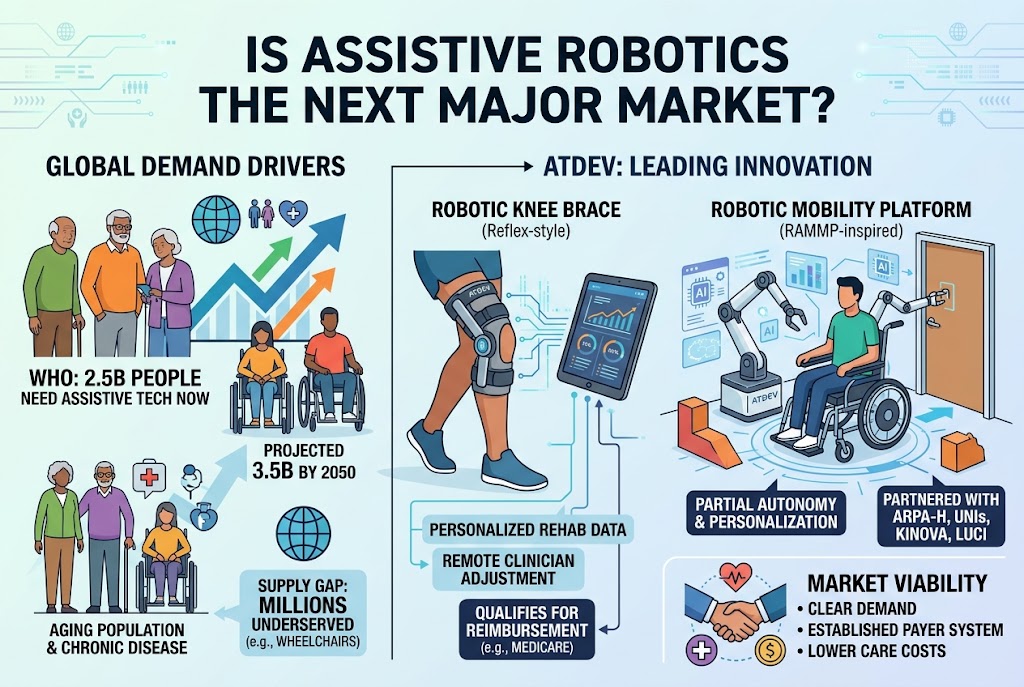
The numbers behind assistive technology are large and growing. According to the World Health Organization, more than 2.5 billion people worldwide need one or more assistive products today, and that figure is expected to reach 3.5 billion by 2050 as populations age and chronic disease rises. The WHO also projects that the number of people aged 60 and older will double to 2.1 billion by 2050, while those aged 80 and older will triple to 426 million.
Supply has not kept pace. The WHO estimates that of the roughly 80 million people who need a wheelchair, only 5% to 35% have access to one, depending on the country. For robotics companies looking beyond industrial automation, that gap looks less like a niche and more like an underserved mass market.
Built by Users, for Users
ATDev was co-founded by CEO Todd Roberts, a mechanical engineer whose graduate work focused on exoskeletons, and Chief Marketing Officer Owen Kent, a lifelong wheelchair user with muscular dystrophy. The two met as roommates at UC Berkeley.
“I have no movement below my neck. But I’m able to live independently thanks to technology, and my amazing caregivers,” Kent told MassRobotics earlier this year.
The company’s first commercial product, Reflex, is an internet-connected robotic knee brace for post-operative physical therapy. Clinicians can adjust it remotely while it collects performance data, so therapy can be personalized without constant in-person visits.
Why the Economics Decide the Market
Assistive robotics faces a hard commercial truth: advanced devices are expensive, and many people who need them cannot pay out of pocket. ATDev has leaned into reimbursement as a core strategy. “We don’t want to build devices that people can’t afford,” Kent told the Center for Data Innovation, noting that Reflex qualifies for reimbursement through Medicare and other programs in many states.
The company also frames robotics as a way to stretch a strained care workforce rather than replace it. “We don’t believe that you’ll ever replace clinicians with devices, but what we can do is build them better tools so they can extend their reach,” Kent said in an interview with HomeCare.
AI Turns the Wheelchair Into a Platform
The bigger bet is RAMMP, the Robotic Assistive Mobility and Manipulation Platform, a program backed by up to $41.5 million over five years from the federal Advanced Research Projects Agency for Health (ARPA-H) and led by the University of Pittsburgh’s Human Engineering Research Laboratories. ATDev joins industry partners Kinova and LUCI, with Carnegie Mellon, Cornell and Northeastern as university partners. ATDev is leading work on a new operating system and simulation platform for assistive technology.
According to the University of Pittsburgh, the prototype can climb and descend high curbs and uses a seven-degree-of-freedom robotic arm with cameras and machine learning to open doors, retrieve drinks and bring items to the user’s mouth. Users can choose how much autonomy the system takes on, which is where personalization and AI meet.
What It Means for the Robotics Industry
Much of the robotics spotlight has fallen on humanoids and warehouse automation, but assistive robotics offers something many of those markets are still chasing: a clear, measurable need and an established payer system. If companies like ATDev can prove that AI-enabled devices lower care costs and qualify for reimbursement at scale, assistive technology could become one of the first home robotics markets with real, recurring revenue.
Leave a Reply