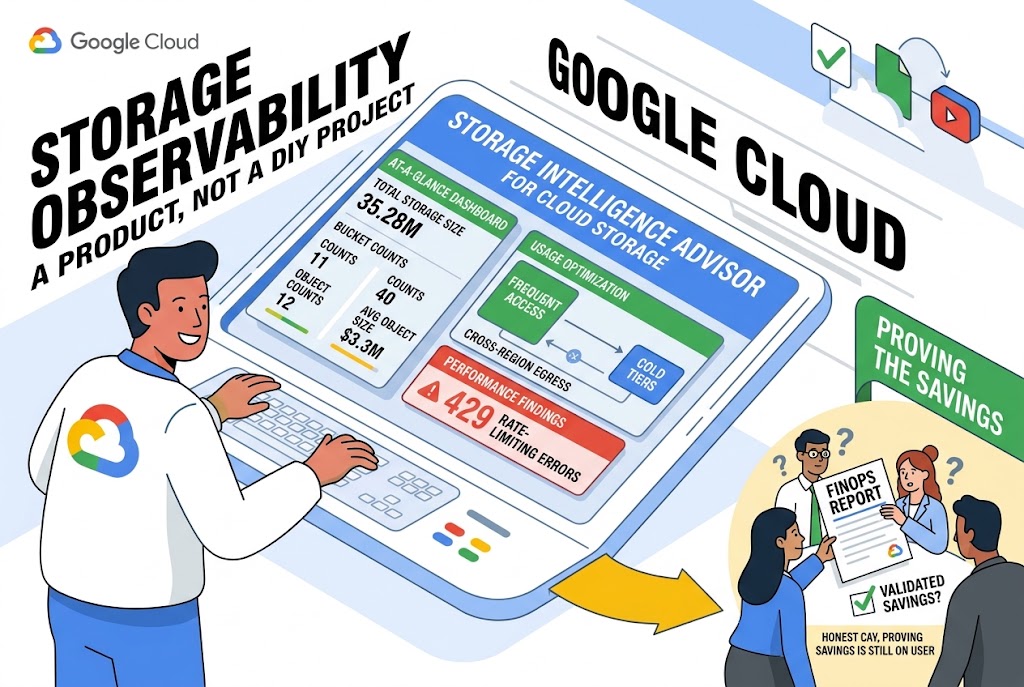
Google Cloud has moved Storage Intelligence Advisor for Cloud Storage to general availability, formalizing what had been a collection of logs, custom dashboards, and third-party FinOps tooling into a single managed interface that spans individual projects, folders, and entire organizations. The move lands as Google Cloud is already the fastest-growing of the three major hyperscalers by a wide margin, and the company appears to be betting that owning the storage-cost conversation natively, rather than ceding it to third-party FinOps platforms or homegrown scripts, helps sustain that growth rate as enterprise storage bills climb alongside AI workloads.
What Storage Intelligence Advisor Actually Does
The advisor bundles three previously disconnected capabilities into one console: storage metrics collection, anomaly detection, and recommended next steps. Google organizes the output into three tiers: metrics (raw data points like storage volume and operation rates), findings (detected anomalies requiring attention), and next steps (actionable recommendations), paired with a real-time “At a glance” dashboard showing total storage size, bucket counts, object counts, and average object size for whatever project, folder, or organization scope a user selects. Findings fall into two categories: usage optimization, such as frequently accessed data sitting in cold-tier storage classes or unexpected cross-region egress spikes, and performance, such as 429 rate-limiting errors degrading application reliability. The tool supports VPC Service Controls for data-exfiltration protection at the project level, though folder- and organization-level resources still rely on IAM-based management instead.
Why Google Is Productizing This Now
The timing lines up with a growth gap Google Cloud has been opening up on both larger rivals. Synergy Research Group’s Q2 2026 tracker put global cloud infrastructure market share at 28% for AWS, 20% for Microsoft Azure, and a record 15% for Google Cloud, with the three combining for 63% of a market that hit $143.4 billion in the quarter, up 43% year-over-year and the fastest pace the category has logged in eight years. Google Cloud’s own segment revenue reached $24.8 billion in Q2, up 82% year-over-year, comfortably outpacing AWS’s roughly 37% growth and Azure’s roughly 40% growth over the same stretch. Google is still third by absolute share, but a growth gap that wide means every enterprise renewal cycle is a chance to close distance on the leaders, and a native FinOps and observability layer is a classic land-and-expand lever: once storage cost governance lives inside Google’s own console, moving that workload’s cold-tier archival to a cheaper competitor becomes visible friction instead of an invisible migration.
The Honest Caveat: Formalizing Isn’t the Same as Proving
GA status doesn’t fully close the gap between Google’s pitch and what the tool actually delivers. Storage Intelligence Advisor surfaces findings and recommendations, but validating that acting on them actually reduced the bill is left to the customer’s own FinOps process. Google isn’t attaching a savings guarantee to the feature. That’s a meaningfully more modest product than it might sound like at first read, and it’s the detail procurement teams will scrutinize when they line this up against AWS’s S3 Storage Lens or Azure’s Storage Insights during a vendor bake-off.
Adoption Is Already Ahead of the GA Announcement
Google says roughly 70% of its largest Cloud Storage customers, organizations managing 50 billion objects or more, were already using Storage Intelligence in some form before today’s GA milestone, which suggests the company treated general availability as a formality for its highest-value accounts rather than a starting gun. That adoption number also fits into a broader 2026 storage push Google has branded around three pillars: high-performance infrastructure for AI training and inference (including a Rapid Bucket tier Google claims delivers 15 TB/s of bandwidth and sub-millisecond latency), “Smart Storage” that auto-generates metadata for AI agents, and Storage Intelligence itself as the management layer tying both together. Positioned against that backdrop, today’s GA release reads less like a standalone feature launch and more like Google formally productizing a capability its biggest AI customers were already relying on informally.
Where This Leaves Google Cloud Against AWS and Azure
AWS’s S3 Storage Lens has had a multi-year head start (it’s been generally available since 2020) and deeper default integration with AWS Cost Explorer and Trusted Advisor. Azure’s Storage Insights ships bundled with Azure Monitor, a product most Azure customers already have open for other purposes. Google’s advisor is newer to GA and, per its own documentation, still leans on IAM rather than VPC Service Controls once monitoring scope moves above the individual project level, a gap security-conscious enterprise buyers will notice during evaluation. But Google doesn’t need storage observability to be the best in the category to make it work competitively; it needs to be good enough to remove one more reason for AI-workload customers already choosing Google Cloud for TPU access and Gemini integration to route their storage spend anywhere else. At 82% year-over-year growth, Google Cloud is no longer playing catch-up on adoption. This GA release is about making sure it doesn’t lose share on cost governance once those new workloads are already running inside its cloud.
Leave a Reply