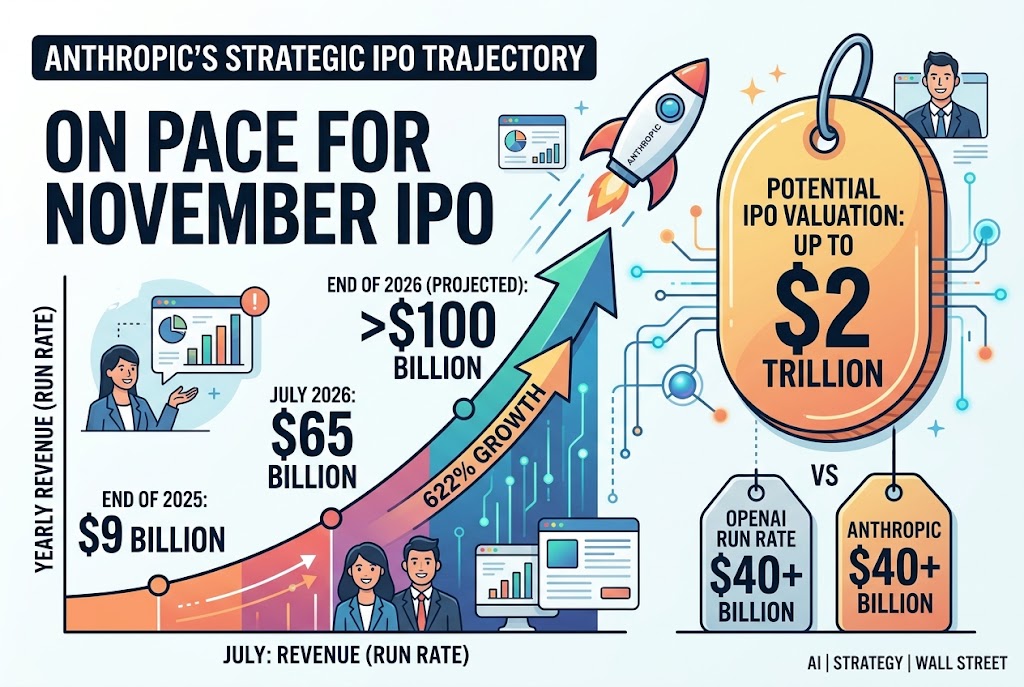
Anthropic‘s revenue run rate is reshaping how enterprise buyers, cloud providers, and rival labs size up the generative AI market. Anthropic told investors its annualized revenue climbed to $65 billion in July, up from $47 billion in May and just $9 billion at the end of 2025, and people briefed on the numbers now expect the figure to clear $100 billion before year-end, a run rate that, if it holds, implies the company added more than $90 billion in annualized revenue in a single year.
A $100 Billion Run Rate Built in Eight Months
The scale of the acceleration is the real story. Anthropic’s run rate grew 622% between the end of 2025 and July 2026, adding $18 billion in just the two months between May and July alone, a 38% jump in a single reporting window. For context, that two-month gain alone exceeds the entire annualized revenue base most enterprise software companies take a decade to build. Anthropic’s last private valuation, set in late May, was $965 billion; a $2 trillion IPO valuation would roughly double that in under six months.
Why Anthropic Is Outpacing OpenAI on the Metric Investors Actually Watch
Anthropic’s $65 billion July figure sits about $25 billion above OpenAI’s run rate, which had roughly doubled from $20 billion at the end of 2025 to just over $40 billion by the same point. Both figures come from people briefed on investor materials rather than the companies’ own disclosures, and the two labs may calculate the metric differently: enterprise API consumption, coding-agent usage, and Claude’s growing foothold inside regulated industries like financial services and healthcare all factor into Anthropic’s mix in ways that aren’t fully comparable to OpenAI’s more consumer-weighted ChatGPT revenue. But the gap itself has become a talking point among the investors now deciding how to price Anthropic’s IPO book.
The November Timing Bet
Anthropic is targeting a November listing, later than the October debut some investors had expected, specifically so it can disclose a full quarter of third-quarter results before pricing. That decision reportedly predates the current wave of public debate over whether frontier AI development is moving faster than safety infrastructure can keep pace with, a debate that has included direct sparring between the Trump administration and California Governor Gavin Newsom over mandatory shutoff mechanisms for frontier models. A November filing gives Anthropic one more quarter to prove the growth curve is durable rather than front-loaded, but it also means pricing the deal squarely inside a news cycle where AI safety and AI capex are both live political issues heading into November’s midterms.
What a $2 Trillion Valuation Would Mean for Enterprise AI Spending
If Anthropic prices anywhere near $2 trillion, the IPO would be sized to raise as much as $100 billion, surpassing the record SpaceX set in June, and would instantly become one of the largest technology listings in history. For enterprise buyers, the number matters beyond bragging rights: a valuation of that size effectively prices in years of continued double-digit-percent quarterly growth, which means Anthropic’s enterprise contracts, coding-tool adoption (Claude Code chief among them), and cloud-partner economics with Amazon and Google all need to keep compounding at a pace few software categories have ever sustained. Any deceleration between now and pricing becomes a headline risk in a way it wouldn’t for a private company.
The Quarterly Numbers Behind the Run Rate
The annualized figure tends to grab headlines, but the underlying quarterly numbers show just how fast the base itself is moving. Anthropic’s actual first-quarter 2026 revenue came in at $4.73 billion; by the second quarter, preliminary figures put the company at $11.5 billion for the quarter alone, nearly a 2.5x sequential jump in three months. That kind of quarter-over-quarter acceleration is what turns a $47 billion run rate in May into $65 billion by July, and it’s the pattern investors pricing the IPO book are extrapolating out to justify a $100 billion-plus exit run rate for the full year. It also means Anthropic’s public quarterly filings, once it lists, will draw intense scrutiny for the first time on whether that pace is holding or merely a pre-IPO peak.
Where OpenAI’s Silence on Going Public Leaves the Competitive Balance
The clearest competitive signal is what OpenAI isn’t doing. CEO Sam Altman said in September that taking OpenAI public in 2026 would be “an ill-advised moment,” citing AI safety concerns, a position that, intentionally or not, cedes the public-market narrative to Anthropic for at least the rest of the year. That leaves Anthropic as the first frontier lab to face the scrutiny of quarterly earnings calls, public short-sellers, and SEC disclosure requirements, while OpenAI continues to raise on private terms shielded from that same pressure. If Anthropic’s public debut goes well, it sets a valuation benchmark that every other AI lab, and every enterprise customer negotiating multi-year contracts with either company, will be measured against for years to come.
Leave a Reply