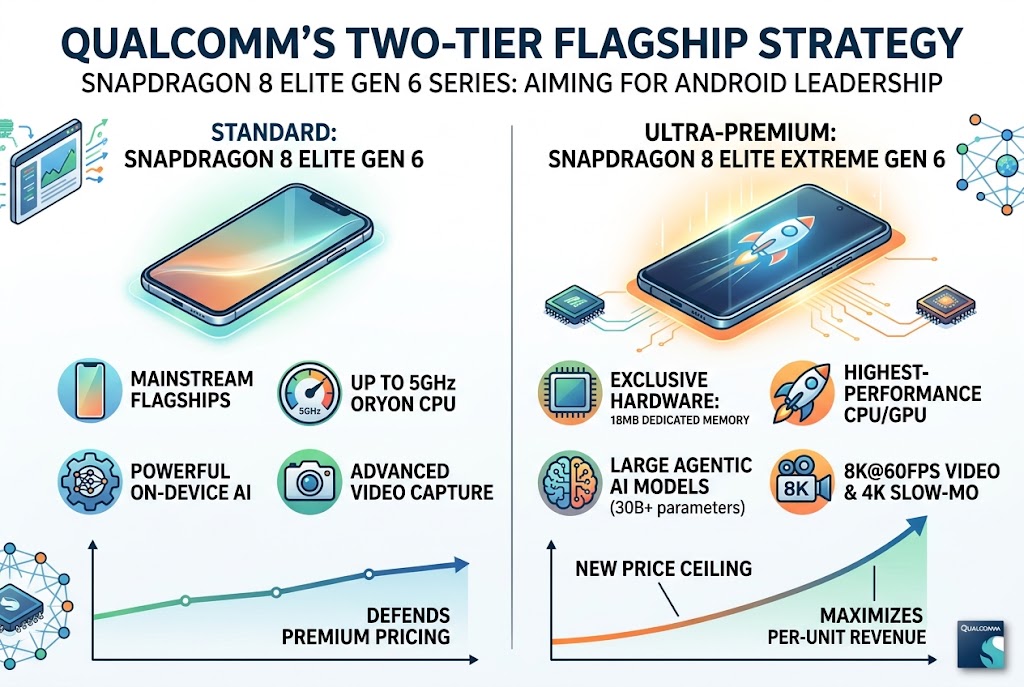
Qualcomm unveiled two flagship smartphone processors on Tuesday, the Snapdragon 8 Elite Gen 6 and the Snapdragon 8 Elite Extreme Gen 6, at the moment its core handset business most needs a catalyst. Handset chip revenue fell 20% year over year to $5.09 billion in the company’s fiscal third quarter, and the new 2nm platforms represent Qualcomm’s most aggressive attempt yet to defend premium Android pricing by moving large AI workloads off the cloud and onto the phone.
The company introduced both chips on the opening day of its Snapdragon Summit, which runs Sept. 22 through Sept. 24. For the first time, Qualcomm is shipping two flagship-class mobile platforms in the same product cycle rather than one.
Two Tiers Give Qualcomm a New Price Ceiling in Android
The split creates a premium above the premium. The standard 8 Elite Gen 6 covers mainstream flagships, while the Extreme Gen 6 carries exclusive hardware: 18MB of dedicated Adreno High-Performance Memory, Adreno Neural Fusion, 8K video capture at 60 frames per second, 4K slow motion at 240 frames per second and native Advanced Professional Video recording.
“By designing two innovative platforms, we’re giving OEMs greater choice as we collectively shape the capabilities of the next generation of intelligent, personalized, mobile experiences,” said Chris Patrick, senior vice president and general manager of mobile handsets at Qualcomm, as reported by Thurrott.
The structure mirrors Apple’s Pro and non-Pro iPhone silicon, and it lets Qualcomm charge more per unit for its best chip while component costs keep climbing.
The Numbers Behind the 5GHz Headline
Both chips use a 2nm process and pair two Oryon prime cores clocked at up to 5GHz with six performance cores at up to 4GHz, backed by a 16MB Oryon Flex Cache. Notebookcheck calls them the first 2nm chips to break the 5GHz barrier.
Against the previous generation, Qualcomm claims the Extreme model delivers 13% more CPU performance with 37% lower CPU power consumption, 44% higher graphics performance with 40% better GPU efficiency, and a 35% faster Hexagon NPU with 33% better performance per watt. The standard chip posts smaller gains: 10% on CPU, 35% on GPU and 14% on NPU, with a 20% improvement in AI performance per watt, according to Unite.AI.
Agentic AI Moves From the Data Center to the Handset
Qualcomm built its pitch around agentic AI, meaning assistants that act on a user’s behalf across apps. The Extreme chip can run mixture-of-experts models larger than 30 billion parameters with 32K-token context windows entirely on the device. A new feature called Personal Scribe builds a local knowledge graph from a user’s messages and emails, and the standard chip adds what Qualcomm calls zero-prompt assistance that learns preferences and coordinates tasks without constant instruction.
That matters to enterprise buyers for two reasons. Every inference that runs locally is one that a cloud provider does not bill for, and data that never leaves the handset is far easier to govern under privacy and compliance rules. Qualcomm is betting that IT leaders will value both as agent workloads multiply.
Why Qualcomm Needs This Launch to Land
The financial backdrop is stark. In its fiscal third quarter, Qualcomm reported total revenue of $9.95 billion, down 4% year over year, according to Futurum Group. Automotive revenue jumped 61% to $1.59 billion and IoT rose 9% to $1.83 billion, but the 20% drop in handsets outweighed both. Management blamed memory constraints, input cost inflation and weaker premium demand, and flagged double-digit pricing actions to offset higher wafer, packaging and memory costs.
Apple compounds the pressure. Qualcomm told investors its share of the new iPhone cycle would come in materially below its prior 20% estimate as Apple shifts to its in-house C2 modem in the iPhone 18 Pro.
Samsung Anchors a Deep Customer Roster
Qualcomm named Samsung, Honor, iQOO, Motorola, OnePlus, Oppo, Redmi, RedMagic, vivo and Xiaomi as launch partners, with devices expected in the coming weeks. Motorola’s Signature 27 is the first phone announced with the Extreme chip, and Samsung’s Galaxy S27 series, expected in early 2027, will serve as the platform’s highest-volume showcase.
How the Launch Reshapes the Fight With MediaTek and Apple
MediaTek moved first. Its Dimensity 9600 Pro, announced Sept. 15, also uses a 2nm process, tops out at 4.55GHz and supports on-device agentic models up to 30 billion parameters. Qualcomm’s answer is a higher clock ceiling, 8K60 capture and a dedicated Extreme tier that MediaTek does not yet match, giving Qualcomm a spec-sheet argument for the Android makers that sell the most expensive phones.
Apple is the harder problem. Its vertical integration, from A-series processors to C-series modems, keeps shrinking what used to be Qualcomm’s largest single customer relationship. The two-tier Snapdragon strategy is therefore as much defensive as offensive: Qualcomm needs Samsung, Xiaomi and the rest of Android to ship the Extreme chip in volume and at higher prices to replace the iPhone revenue it is losing. If they do, Qualcomm holds its grip on premium Android. If they default to the cheaper tier or to MediaTek, the handset slide that defined this fiscal year will carry into the next.
Leave a Reply