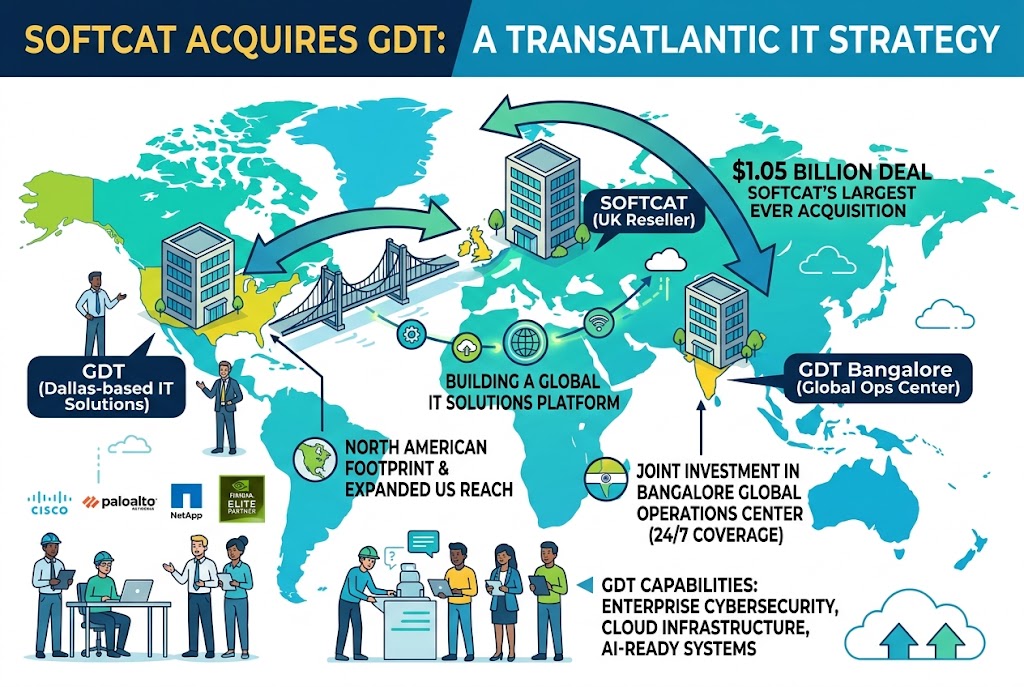
GDT is being acquired by Softcat for $1.05 billion (£785 million), the largest transaction in the UK reseller’s history and a sharp break from the organic growth strategy that has defined the company for two decades. GDT, a Dallas-based IT solutions provider owned by private equity firm H.I.G. Capital since 2021, will keep its name, leadership team and workforce as a wholly owned Softcat subsidiary, but the deal instantly gives Softcat the North American and India footprint it has spent years searching for.
The Numbers Behind Softcat’s Biggest Bet Ever
Panmure Liberum projects GDT will generate roughly $240 million in gross profit and $80 million in EBITDA for the calendar year, putting the purchase price at about 13.5x EBITDA by two separate analyst estimates, with Panmure Liberum and Peel Hunt landing on the same multiple independently. Citi took a different angle, calling the roughly 4.4x gross profit multiple reasonable on its own terms while noting the deal “dilutes what had until now been a purely organic performer.” The transaction is expected to close by the end of Q1 calendar year 2027, pending regulatory approval.
How Softcat Is Paying for It
Softcat is funding the deal with a £354 million equity placing priced at 1,890 pence per share, roughly £100 million of existing cash, and up to £550 million in new debt facilities. That financing mix pushes the company’s pro forma leverage to 1.3x, which Softcat expects to bring back below 1x by July 2028. For a company that has grown almost entirely through organic expansion since its founding, raising new equity and taking on acquisition debt at this scale is itself the headline, independent of what GDT actually does.
What GDT Actually Became Under H.I.G. Capital
GDT looked very different when H.I.G. Capital bought in during 2021. Carriers made up roughly 80% of its customer base at the time; that figure has fallen to about 35% today as the company pushed into cybersecurity, cloud infrastructure, and data center modernization for enterprise customers, doubling its salesforce with new architects and consultants along the way. GDT built partnerships with Cisco, Palo Alto Networks, NetApp, and HPE, and was named an Nvidia Elite Compute Partner in 2026, credentials that read less like a network integrator and more like the AI-infrastructure specialist Softcat is now buying into. GDT CEO Shawn O’Grady summed up the logic bluntly: “If you really have ambition to be big in the industry, it’s hard not to be in the U.S.”
How Analysts Are Reading the Deal
The sell-side response has been broadly positive but not uncritical. Peel Hunt, which rates the stock Buy with a 2,447 pence target, argued that “the bottleneck in corporate AI has shifted from securing chips to the harder work of integration, networking, storage and security,” and modeled more than 9% EPS accretion by July 2028. Panmure Liberum, also Buy-rated with a 1,920 pence target, pointed to GDT’s 4.6 Glassdoor rating as evidence the cultural fit Softcat emphasized in its announcement is more than talking points. Citi’s more measured take, that the price is fair but the strategic shift is real, is the one worth watching: it’s the clearest signal that Softcat is now being valued, at least partly, on its ability to execute integrations rather than just compound organically.
The Bangalore Bet: Where the Combined Company Actually Gets Built Out
Beyond the balance sheet, the deal’s most concrete integration commitment is a joint investment in expanding GDT’s existing Global Operations Center in Bangalore, adding engineering expertise, optimized business systems, and 24/7 coverage. That’s a tell about where Softcat expects the growth to come from: not primarily new logos in the UK or US, but the ability to service a combined customer base around the clock as enterprise IT buying shifts toward AI-ready infrastructure. It also lands inside a broader software lifecycle engineering market that analysts covering the deal peg at $167.96 billion in 2023, growing to $343.97 billion by 2028, roughly 15.4% annually, with more than 45% of technology decision-makers planning to increase spending over the next year. Softcat is betting a bigger, more geographically complete GDT wins a larger share of that spending than either company could capture alone.
The Competitive Read: Softcat Chases Computacenter Into North America
This deal only makes sense against the backdrop of Softcat’s long rivalry with Computacenter, the UK IT reseller it overtook on domestic revenue back in 2021 but which remains larger globally and has itself been active in North America, completing two acquisitions there in 2026 alone. Softcat spent years searching for a North American platform with the scale, technical depth, and cultural fit to compete on that same transatlantic footing, and GDT’s transformation from a carrier-focused network integrator into a Cisco, Palo Alto Networks, and Nvidia-credentialed AI infrastructure player made it the rare target that could check every box at once. For enterprise buyers, the practical effect is a bigger, more capitalized alternative to Computacenter, CDW, Insight Enterprises, and World Wide Technology for organizations that need a single partner spanning UK, US, and Indian operations. Whether that combination holds together operationally is the multi-year test now facing Softcat’s first major acquisition; whether it works financially is the test analysts have already started pricing in.
Leave a Reply