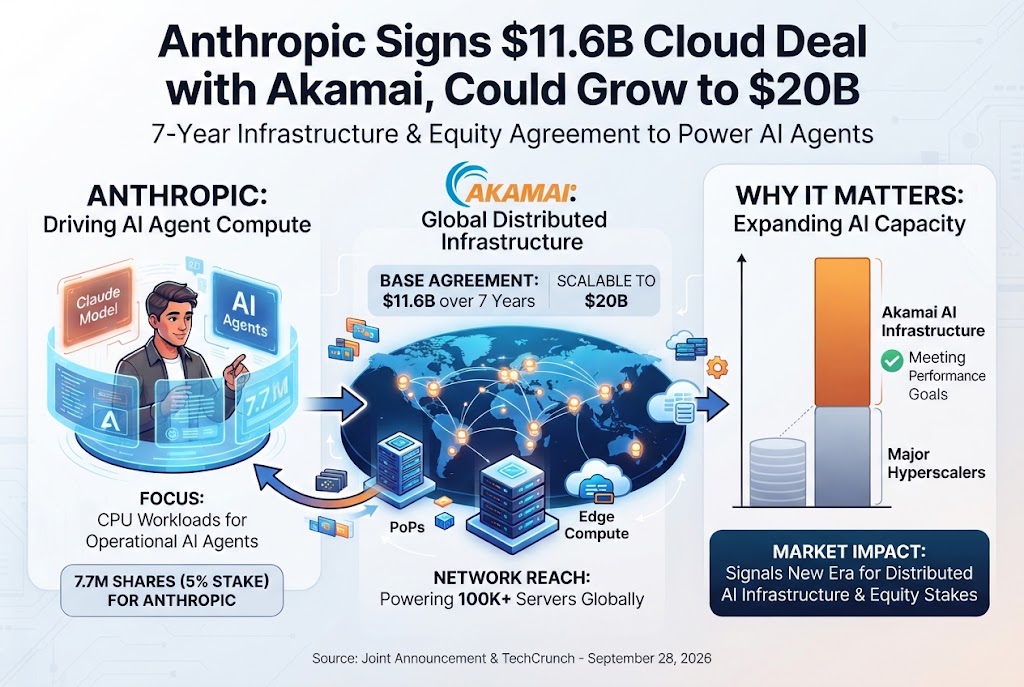
Anthropic has agreed to spend $11.6 billion over seven years on cloud infrastructure from Akamai, with the deal structured to grow to roughly $20 billion if Anthropic keeps expanding its usage, according to a report from TechCrunch and a joint announcement from the two companies. The agreement is the largest contract in Akamai’s history, and its shares jumped as much as 17 percent in after hours trading once the news broke.
The commitment dwarfs a previous arrangement between the two companies, a roughly $1.8 billion deal reported in May, and marks Akamai’s arrival as a serious player in AI infrastructure after building its reputation on content delivery and edge computing.
What Akamai is providing
Akamai Cloud will supply distributed infrastructure and software to support the CPU workloads behind Anthropic’s Claude models, drawing on the company’s global network of points of presence and its experience running infrastructure for large enterprises. The deal’s focus on CPU capacity rather than GPU capacity is notable on its own: it signals that a meaningful share of Anthropic’s near term compute demand is coming from AI agents handling operational tasks rather than from training ever larger models, a workload pattern that leans more heavily on CPU resources.
“Anthropic is advancing the AI revolution and we are thrilled they chose Akamai’s capabilities for building and operating AI infrastructure at scale,” said Akamai co-founder and chief executive Tom Leighton.
An equity stake attached to the contract
Akamai issued Anthropic a warrant convertible into approximately 7.7 million shares of common stock, or roughly 5 percent of Akamai’s outstanding stock, at a strike price of $111.33 per share. About 2 percent of that stake vests immediately on Anthropic’s first payment, with the rest tied to further spending: Anthropic unlocks another 1 percent of equity for every additional $3 billion it commits, up to the deal’s roughly $20 billion ceiling. It is the first time Akamai has attached a warrant to a cloud contract.
That structure puts Akamai in the same company as Amazon, Google, Microsoft and AMD, all of which have supplied Anthropic with infrastructure or chips in exchange for equity stakes in recent deals. Anthropic chief executive Dario Amodei has previously said the company operates at a smaller scale than some of its competitors in these arrangements, even as the dollar figures involved keep climbing.
What it costs Akamai, and what it pays back
Akamai expects to spend approximately $5.5 billion building out capacity to meet its commitments under the base agreement, and it is adding $1.7 billion to its current year capital expenditures for advance purchases of components such as memory. In exchange, the company expects the deal to generate between $150 million and $300 million in revenue in 2027, ramping to roughly $1.7 billion annually by the end of 2028. Akamai said it does not expect the agreement to change its 2026 guidance.
The arrangement is also conditional. According to TechCrunch’s reporting, the deal depends on Akamai meeting specific delivery and service availability requirements, and either company can terminate under certain conditions, a structure that gives Anthropic leverage to hold its new infrastructure partner to a performance bar as it scales up.
Why it matters
For an industry still dominated by the three major hyperscalers, Akamai’s entry as a primary infrastructure partner for one of the best funded AI labs is a signal that demand for AI compute, and particularly CPU heavy agentic workloads, has outgrown what Amazon, Google and Microsoft alone can supply on the timelines AI companies want. Anthropic is reportedly exploring a funding round that could value the company at more than $900 billion, and deals like this one, which trade future infrastructure spending for equity upside, are becoming a standard way for AI labs to secure capacity without depleting cash reserves needed for research and model training.
Leave a Reply