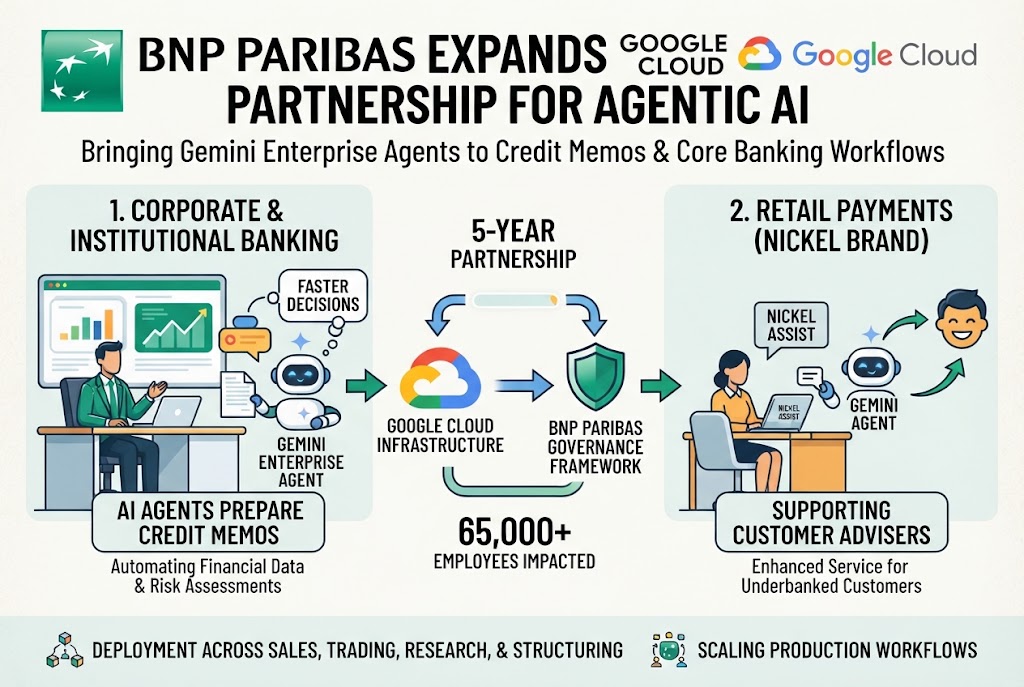
BNP Paribas has signed a five year partnership with Google Cloud that gives the French bank access to Gemini Enterprise and a broader set of agentic AI tools, according to a joint announcement from the two companies. The deal expands an existing relationship and is aimed at pushing AI agents into everyday work across BNP Paribas’s corporate and institutional banking operations, its retail payments arm, and eventually its sales, trading, research and structuring desks.
The partnership gives BNP Paribas access to Google Cloud’s AI optimized infrastructure alongside Gemini models, which the bank will integrate into LLM@CIB, its internal generative AI assistant already used by more than 65,000 employees. That existing footprint makes the rollout less a pilot program than an expansion of a tool employees are already using day to day.
Where the AI agents go first
The initial deployments are concentrated in BNP Paribas’s Corporate and Institutional Banking division, where AI agents built on Gemini Enterprise will help prepare credit memos, a traditionally labor intensive process that involves pulling together financial data, risk assessments and narrative analysis before a loan or credit decision can move forward. From there, the bank plans to expand agent deployment across sales, trading, research and structuring activities.
Separately, the partnership extends to Nickel, BNP Paribas’s payment services brand aimed at underbanked customers, where a tool called Nickel Assist will support roughly 200 customer advisers. That pairing, enterprise grade AI for institutional banking on one side and customer service AI for a mass market payments product on the other, illustrates how broadly BNP Paribas is betting on agentic AI across very different parts of its business.
What executives are saying
“A multi-cloud and multi-model approach gives us the flexibility to select the right model and infrastructure” for the bank’s requirements, said Marc Camus, BNP Paribas’s group chief information officer, a framing that signals the bank is not putting all of its AI infrastructure eggs in one basket even as it deepens its Google Cloud relationship.
Google Cloud chief executive Thomas Kurian struck a broader note about where the industry is headed: “Agentic AI marks a critical shift in how global financial institutions streamline operations and serve clients.”
Governance stays with the bank
Neither company disclosed the financial terms of the agreement. BNP Paribas said the partnership will operate within its existing security and data governance framework, with agent authentication and access controls layered on top rather than replacing the bank’s current compliance infrastructure, a detail that matters given how tightly regulated data handling is for a global systemically important bank operating across dozens of jurisdictions.
Why it matters
The deal is another data point in a broader pattern of large banks moving past AI pilots and into production deployments tied to specific, measurable workflows rather than general purpose chatbots. Credit memo preparation is exactly the kind of repetitive, document heavy task that banks have identified as a near term return on investment case for generative AI, and BNP Paribas’s decision to start there, rather than with a more visible but harder to measure use case, suggests the bank is prioritizing efficiency gains it can track over splashier announcements. For Google Cloud, landing a bank of BNP Paribas’s size as a flagship agentic AI customer strengthens its pitch to other global financial institutions still weighing which cloud and model provider to build their AI strategy around.
The announcement also lands amid intensifying competition among the major cloud providers for large financial services customers, a segment that brings enormous data volumes, strict compliance requirements and long term contract value once a bank commits to a platform. Microsoft and Amazon have each struck similar high profile agentic AI partnerships with global banks over the past year, and BNP Paribas’s decision to lean further into Google Cloud, while explicitly preserving a multi-cloud posture, suggests banks are increasingly comfortable spreading AI workloads across providers rather than consolidating around a single vendor the way many did with traditional cloud infrastructure.
Leave a Reply