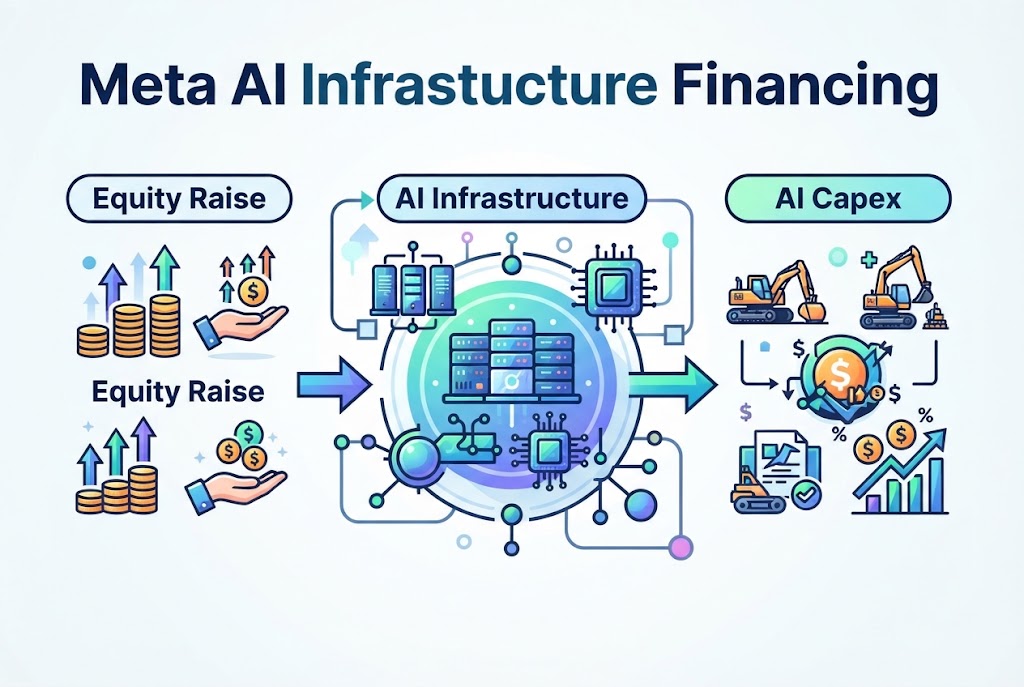
Meta priced $25.0 billion of Class A common stock and $12.5 billion of mandatory convertible preferred depositary shares, turning to equity markets to help fund an AI infrastructure buildout that now outruns its operating cash flow. The two offerings, launched and priced on Monday, October 26, 2026, began trading on Tuesday and form the opening leg of an equity program that could reach about $97.5 billion, which Reuters described as a record equity raise.
Meta upsized the common stock offering from $22.5 billion at launch. Both offerings are expected to close on October 29, and neither is conditioned on the other.
Meta sold 40,000,000 Class A shares at $625.00 each through forward sale agreements, according to the pricing term sheet filed with the SEC. The price sat below Monday’s last reported sale of $630.56. Meta receives no cash at closing. It expects net proceeds of about $24.9 billion at an initial forward price of about $622.92 per share, or about $28.7 billion if underwriters exercise their option for 6,000,000 more shares, with settlement on or before November 19, 2027.
The preferred leg consists of 250,000,000 depositary shares at $50 each, each representing a 1/20th interest in a share of 6.50% Series A Mandatory Convertible Preferred Stock. Each preferred share converts into between 1.3620 and 1.6000 Class A shares on or about August 15, 2029, with a threshold appreciation price of $734.21, about 17.5% above the offering price. Meta expects about $12.5 billion in net proceeds from the preferred offering, or about $14.3 billion with the over-allotment option, and has applied to list the depositary shares on Nasdaq under “METAM.”
Morgan Stanley and Goldman Sachs led both deals as joint book-running managers. Allen & Company, BDT & MSD Partners, Centerview Partners, Jefferies, Lazard and Raine Securities served as co-managers. Meta stated that it will use proceeds for general corporate purposes.
The raise follows a third quarter in which Meta’s spending overtook its cash generation. Meta reported Q3 revenue of $64.60 billion, up 26% year over year, but capital expenditures, including principal payments on finance leases, reached $34.91 billion and free cash flow turned negative at $2.12 billion, according to its October 21 earnings release. Reuters noted it was Meta’s first negative quarter in more than a decade.
Meta narrowed its 2026 capital expenditure outlook to $135 billion to $145 billion and declined to give a 2027 figure, saying only that it expects to keep investing heavily in its core business and AI. “We hit major milestones this quarter toward delivering personal superintelligence for everyone,” said Meta CEO Mark Zuckerberg in the earnings release. The offering launch release states that Meta owns data centers in 23 U.S. states, is building four superclusters of more than one gigawatt each, and expects to nearly double total infrastructure capacity in 2026.
NVIDIA, AMD and Broadcom indicated interest in buying up to $5.0 billion of Class A stock in aggregate on the same terms as other investors, though Meta stressed these are not binding commitments. Nvidia separately said it will invest $3 billion in the offering, Reuters reported. The arrangement adds to investor concern about circular AI capital flows, in which chip suppliers help fund their largest customers.
Demand was strong: the upsized stock sale drew orders for about five times the available shares, according to a Bloomberg News report cited by MarketScreener. The stock still slid. Meta closed down nearly 2% at $630.56 on Monday and traded around $623 on Tuesday afternoon, leaving shares down about 10% over five sessions.
William Blair analysts wrote, “We expect investors to continue to question the financing and potential for future capital raises,” while maintaining that Meta will ultimately produce a profitable AI business. That question looms because Meta also plans an at-the-market program of about $60 billion tied to new Class C common stock, with sales not expected to begin until the first quarter of 2027.
Meta is not alone in tapping shareholders. Alphabet raised its equity offerings to $84.75 billion in June, and on Monday SpaceX said an Apollo Global Management affiliate will buy AI chips and server hardware and lease them to SpaceX, with total principal payments of about $40 billion. The same day, banks and Blackstone unveiled a $63 billion structure to lease Broadcom hardware to Anthropic.
The pattern marks a shift. Hyperscalers that once funded AI capex from operating cash now blend debt, leases and equity to stay in the race against OpenAI and Anthropic. Meta held about $82.45 billion in cash and marketable securities and $80.92 billion in long-term debt as of September 30, and Reuters reports it has committed about $825 billion in future spending. Equity gives Meta capacity without stretching its credit profile, but it also hands rivals Alphabet, Microsoft and Amazon a clear benchmark: investors will absorb AI dilution, yet they will price every new raise against evidence of returns.
Leave a Reply