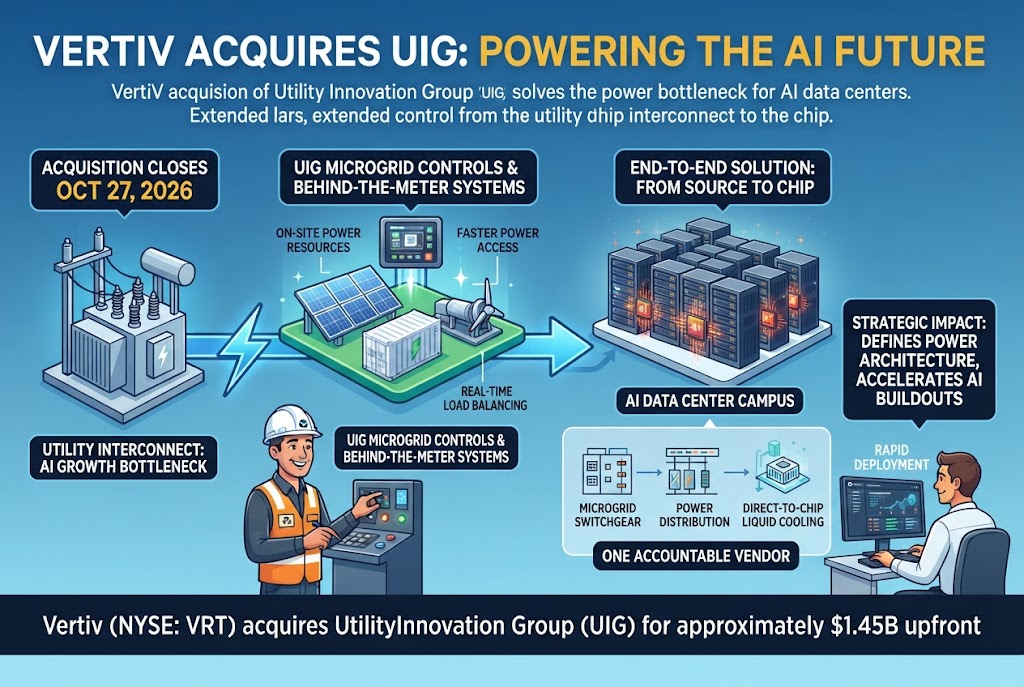
Vertiv (NYSE: VRT) closed its acquisition of UtilityInnovation Group (UIG) on October 27, 2026, paying approximately $1.45 billion in cash upfront for a company that builds microgrid controls and behind-the-meter power systems for data centers. The deal pushes Vertiv’s footprint from the rack and the electrical room out to the utility interconnect, the exact point where AI campuses now stall while they wait for grid capacity.
Vertiv Corporation bought Utility Innovation Holdings, Inc., which operates as UIG. Sellers can collect up to another $1.15 billion in cash if UIG hits EBITDA targets over 12- and 24-month periods, putting the total potential value at $2.6 billion. Vertiv priced the upfront payment at about 13 times UIG’s expected 2027 EBITDA and said the effective multiple drops significantly if the full earnout pays out. The company expects the deal to add to adjusted earnings per share in the first year after closing.
Vertiv frames the acquisition around one bottleneck: electricity. “Access to power has become a critical competitive advantage” for AI data center operators, CEO Giordano Albertazzi said in the completion announcement. When Vertiv first disclosed the agreement on September 2, 2026, Albertazzi put it in sharper commercial terms: “For AI data center operators, competitive advantage increasingly depends on how quickly they can move from site selection to first token.”
UIG targets that delay directly. Founded in 2020 and headquartered in Raleigh, North Carolina, with a European headquarters in Dublin, Ireland, and manufacturing in North Carolina and New Jersey, the company designs power systems that balance load and frequency in real time across behind-the-meter and utility-connected energy resources. Its portfolio includes proprietary controls software, customized microgrid switchgear and energy storage. Vertiv says customers gain faster access to power, onsite capacity beyond what the grid supplies, and one accountable vendor from interconnect to rack.
Vertiv deliberately avoided tying the deal to a single fuel or turbine supplier. In September, Albertazzi said UIG extends Vertiv’s portfolio “upstream to the utility interconnect and onsite power sources, creating a coordinated architecture from source to chip without tying customers to a single generation technology or supplier.” Vertiv plans to offer pre-validated reference designs for grid-connected, bridge-to-grid and islanded sites, which lets the company shape the power blueprint that drives downstream equipment choices.
A vendor that defines site power architecture early holds a strong claim on the switchgear, power distribution and thermal orders that follow. UIG founder and CEO Sidney Hinton said the company aims “to solve the power constraints that are slowing AI data center development.” Hinton previously founded PowerSecure, which Southern Company acquired in 2016 for $431 million, according to DatacenterDynamics.
Vertiv paid cash for UIG while its core business accelerates. The company reported 2025 net sales of $10.23 billion, up 27.7%, and ended the year with a $15.0 billion backlog, up 109%, according to its fourth-quarter 2025 results. In July, Vertiv posted second-quarter 2026 net sales of $3.27 billion, up 24%, and raised full-year 2026 guidance to $13.8 billion to $14.2 billion in net sales, with organic growth of 30% to 32% and adjusted diluted EPS of $6.65 to $6.75. Vertiv reports third-quarter results on October 28, one day after closing.
The acquisition also complements Vertiv’s push into packaged AI infrastructure. On October 26, the company launched Vertiv SmartIT, a pre-engineered platform that combines racks, DC power conversion, direct-to-chip liquid cooling and monitoring for NVIDIA GB300 NVL72 and Vera Rubin NVL72 systems. With UIG, Vertiv now pitches an offering that runs from onsite generation controls to the coldplate.
The earnout structure shifts part of the price onto UIG’s performance, but Vertiv still carries execution risk. Its forward-looking statements flag integration costs, retention of UIG customers and key employees, and whether expected synergies materialize. Vertiv did not disclose UIG’s revenue or customers.
The deal escalates an acquisition race among data center power suppliers. Eaton, which reported 2025 net sales of $27.4 billion and a year-end backlog of about $19.8 billion, bought modular power enclosure maker Fibrebond for $1.43 billion and solid-state transformer developer Resilient Power Systems in 2025, then agreed to acquire Boyd Thermal for $9.5 billion to add liquid cooling. Eaton’s filing, however, makes no reference to behind-the-meter or onsite generation, the niche UIG fills for Vertiv.
Schneider Electric, the sector’s other heavyweight, posted third-quarter revenue of 11.46 billion euros, up 16.9% organically, and raised its 2026 organic revenue growth target to 12% to 14%, Reuters reported on October 16. CEO Olivier Blum said data centers “remained a key growth driver.” Schneider is spending its acquisition capital on software, including a $22.6 billion deal for PTC. Vertiv is betting on a different control point. If grid scarcity keeps dictating where and how fast AI capacity comes online, the vendor that designs the power architecture at the interconnect gains first claim on everything downstream, and Vertiv has now staked out that position with a dedicated microgrid and controls business.
Leave a Reply