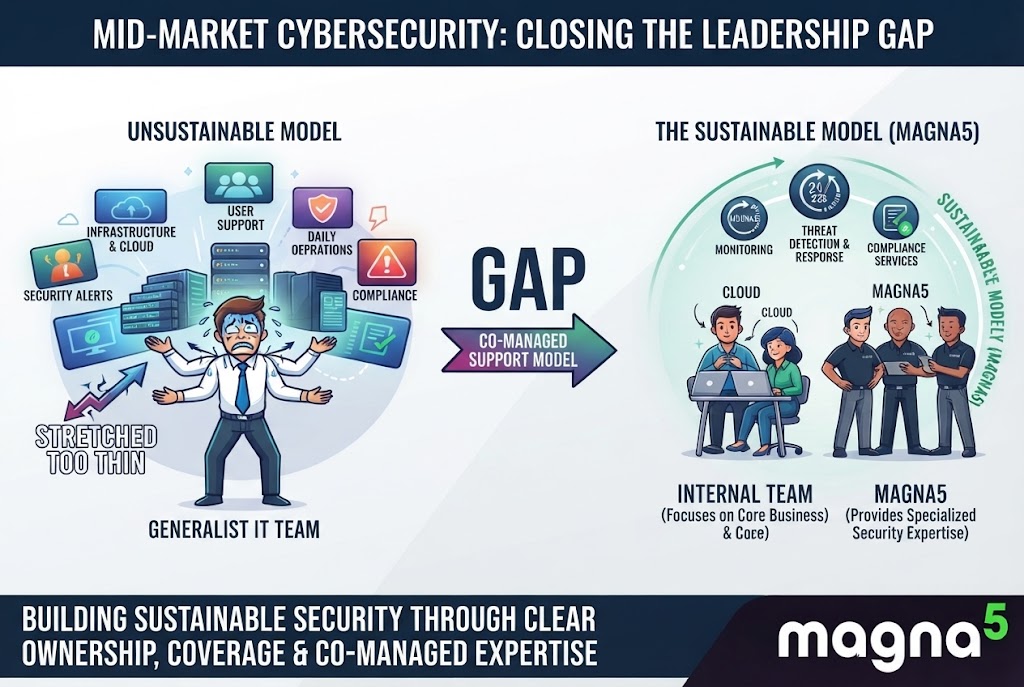
Mid-market companies are carrying enterprise-level cybersecurity demands on the shoulders of generalist IT teams, and the gap is becoming a leadership issue, according to security executives at Magna5, a national managed IT, cybersecurity, cloud and compliance services provider. The company shared its perspective on November 2, 2026, arguing that organizations need a security operating model they can sustain over time rather than one that depends on stretching existing staff further.
The workforce data shows the scale of the problem. Nearly six in 10 cybersecurity professionals reported critical or significant skills needs within their organizations, according to the 2025 ISC2 Cybersecurity Workforce Study. The same study found that budget constraints continue to limit the ability of organizations to hire the expertise they need. For mid-market companies, that pressure often lands on generalist information technology (IT) teams already responsible for infrastructure, cloud environments, user support and day-to-day operations.
William Hale, Senior Director of Virtual Chief Information Security Officer (vCISO) Services at Magna5, said leaders should pay attention when security demands begin to exceed what those teams can reasonably manage. “If leadership finds itself constantly reacting to security gaps instead of proactively managing risk, that’s a structural problem as much as a staffing problem,” Hale said. “At that point, it’s not about working harder; it’s about recognizing the current model has hit its ceiling.”
Detection and response are where the strain tends to show first. Recognizing subtle signs of compromise and responding under pressure require specialized expertise that generalist teams may struggle to maintain alongside routine duties. The World Economic Forum’s Global Cybersecurity Outlook 2026 identifies unequal access to cybersecurity resources and expertise as a continuing resilience challenge, particularly for organizations with fewer resources. Magna5 says its security and vCISO teams work alongside mid-market IT departments to help close that gap.
Round-the-clock coverage is the second pressure point. “Attackers choose the timing, not the target,” said Brandon Bell, Senior vCISO at Magna5. “Monitoring must be continuous so an alert on a holiday weekend gets the same attention as one on a Tuesday morning.”
Technology alone does not close the capability gap, according to the company. Every new security platform creates operational work, including configuration, monitoring, alert review, maintenance and follow-up. For mid-market teams already balancing infrastructure, user support and security responsibilities, that work becomes one more demand on limited staff time.
Bell said trouble often begins when companies buy technology in response to a specific incident. “The result is expensive software generating alerts that nobody is tuning, reviewing, or acting on,” Bell said. The risk is that leadership comes to believe a security gap has been addressed while the underlying operational responsibility remains unresolved.
The answer, Bell said, is to attach a plan to every purchase. “Every tool purchased needs an operational plan attached to it, not just a line item in the budget,” he said. He framed the ownership question as who configures, who reviews alerts, who acts and who reports, and said that is where Magna5 helps mid-market teams build a sustainable model.
For organizations that cannot hire their way out of the problem, co-managed support offers a way to add specialized expertise without replacing the internal team. Hiscox’s 2026 Cyber Readiness Report found that 55% of surveyed organizations were investing in specialist staff as part of their cyber resilience spending, reflecting how widely the demand for specialized security skills is felt. Hale said the model works best when responsibilities are clearly defined. “Internal teams stay in place doing what they do best, while the co-managed partner fills the specific gaps around threats and around-the-clock coverage,” he said. Clear boundaries around routine work, escalation, incident response and reporting help prevent security responsibilities from falling between teams.
Expectations from outside the company are adding to the workload. Customers increasingly ask for evidence of security posture before signing contracts, vendor assessments are becoming more demanding, and cyber insurers can require specific controls before issuing or renewing coverage. Each of those pressures adds to the responsibilities mid-market companies must maintain consistently.
“Cybersecurity responsibilities keep expanding, and the team supporting them does not always expand with them,” Hale said. “Leadership needs to know what the internal team can sustain consistently, where specialized support is needed, and who owns each responsibility. That is how you build a security program the business can maintain.”
For mid-market executives, the takeaway is practical. The question is less whether to invest in security tools and more whether clear ownership, coverage and escalation paths exist for everything the organization already runs. Leaders who can answer those questions for each platform and each shift are better positioned to meet the expectations of customers and insurers.
Magna5 serves small and mid-sized businesses, mid-market organizations and regulated industries across the United States. The company supports critical IT infrastructure, network and data protection, user support and operational resilience through 24/7/365 monitoring, managed security, cloud, backup, disaster recovery and compliance services. Its clients include organizations in the Defense Industrial Base, healthcare, financial services, legal, manufacturing, education, construction, government and professional services. More information is available at magna5.com.
Leave a Reply