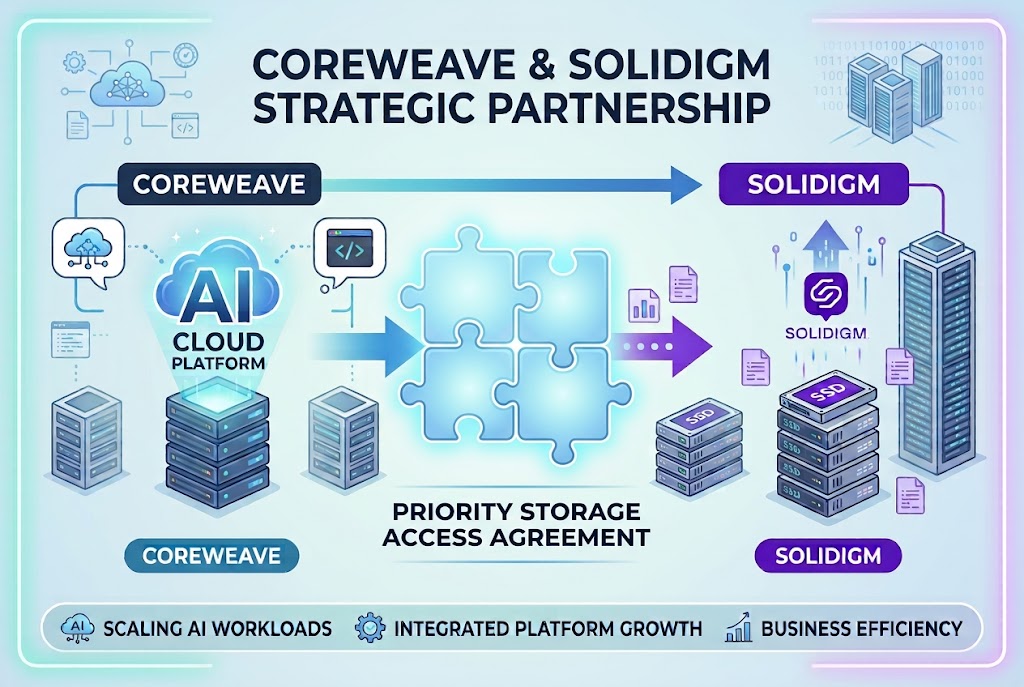
In a significant move to strengthen its full-stack infrastructure, CoreWeave has finalized a multi-year deal with Solidigm to secure high-capacity enterprise storage. The agreement ensures priority access to enterprise solid-state drive capacity, which will help the company scale its infrastructure as customer demand for artificial intelligence workloads continues to surge.
Artificial intelligence models require a tightly coupled combination of compute, networking, software, and storage. As deployment accelerates, securing every component becomes critical to prevent bottlenecks. Storage has emerged as a major constraint for cloud providers, making direct long-term partnerships a vital strategy. By locking in guaranteed capacity early, the platform aims to keep its infrastructure scaling smoothly ahead of customer needs.
Executive leadership highlighted how the agreement fits into their broader platform strategy. “CoreWeave was built to give AI pioneers everything they need in one place, so they can build and deploy without stitching together their own infrastructure,” said Sachin Jain, chief operating officer of CoreWeave. “Storage is part of that promise. This agreement gives us priority access to the storage our roadmap depends on, allowing customers to focus on what they’re building instead of the infrastructure underneath it.”
Solidigm representatives also expressed strong support for the partnership. “Long-term supply commitments are becoming a strategic advantage of staying ahead of demand, and this agreement aligns to that vision,” said Paul Palonsky, executive vice president and head of global sales at Solidigm. “This agreement reflects the confidence Solidigm has in CoreWeave’s growth and its position as a full-stack AI cloud provider. “
The cloud provider continues to report strong momentum across its platform, backed by performance metrics and independent benchmark rankings. By securing a reliable storage supply chain, the company strengthens its position as an integrated cloud provider ready to handle expanding enterprise requirements.
Leave a Reply